

As an Amazon Associate and eBay Partner, toptenpick.com earns from qualifying purchases. Prices and availability are subject to change.
If you have just had braces fitted or tightened and your teeth ache, Sensodyne is unlikely to help — and understanding why saves you both money and disappointment.
There are two completely different kinds of tooth pain involved here. Dentine hypersensitivity is the sharp, brief zing you get from cold drinks or air, caused by exposed dentine tubules conducting stimulus to the nerve. That is exactly what desensitising toothpastes are formulated for: potassium nitrate calms the nerve response, and stannous fluoride or a calcium-phosphate technology physically plugs the tubules. They work, and the evidence behind them is solid.
Orthodontic soreness is something else entirely. When a wire is tightened, the tooth is being pushed through bone, and the periodontal ligament around the root becomes inflamed. That is what makes biting uncomfortable for a few days after an adjustment. It is not coming from the tooth surface at all, so nothing applied to the enamel can reach it. No toothpaste will help, and the things that do help are soft food, cold water and time.
Which does not mean Sensodyne is pointless with braces. It is useful for a different and arguably more important problem. Brackets trap plaque, and demineralisation around them is common — studies put white spot lesions in 25 to 46 per cent of orthodontic patients. Those chalky white marks are permanent enamel damage and they are revealed, humiliatingly, on the day the braces come off. Fluoride is the main agent that prevents them, so what matters in your toothpaste is the fluoride content, not the desensitising ingredient — and several Sensodyne formulations combine both, which is a reasonable pairing if you genuinely have sensitivity as well.
One warning worth having early: do not use whitening toothpaste while wearing fixed braces. It works only on the exposed enamel, so the covered patches under each bracket stay their original shade, and you get a patchwork tooth when they come off.
Ask your orthodontist what they recommend for your case. The ten picks below are the categories worth discussing.
| # | Product | Price | Where to buy |
|---|---|---|---|
| 1 | Sensodyne Pronamel | $5-$10 | Amazon · eBay |
| 2 | Sensodyne Repair and Protect | $6-$12 | Amazon · eBay |
| 3 | Sensodyne Extra Fresh or Daily Care | $4-$8 | Amazon |
| 4 | High-Fluoride Prescription Toothpaste | $15-$35 | Amazon |
| 5 | Fluoride Mouth Rinse | $6-$15 | Amazon |
| 6 | Orthodontic Toothbrush with a V-Trim Head | $5-$15 | Amazon · eBay |
| 7 | Interdental Brushes in Assorted Sizes | $6-$18 | Amazon · eBay |
| 8 | Water Flosser | $40-$120 | Amazon · eBay |
| 9 | Orthodontic Wax | $4-$12 | Amazon · eBay |
| 10 | Disclosing Tablets | $6-$15 | Amazon |
The picks, in detail
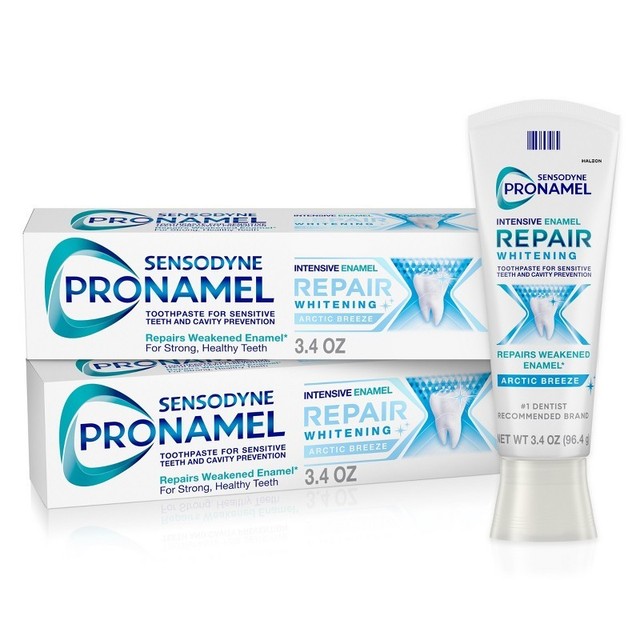
Sensodyne Pronamel
The Sensodyne variant that makes the most sense with braces, because its focus is enamel rather than nerves. Pronamel is formulated to be low in abrasivity and to help strengthen enamel against acid attack, which is precisely the mechanism behind the white spots that form around brackets. It still contains fluoride at the usual over-the-counter level. If you want one tube that serves both the sensitivity and the demineralisation problems, this is the sensible choice within the range.
- Fluoride toothpaste focused on enamel strength
- Low relative abrasivity
- Formulated for acid erosion protection
- Several flavour variants
- Targets the enamel problem braces actually create
- Low abrasivity is kinder around bracket edges
- Widely available and reasonably priced
- Does nothing for post-adjustment soreness
- Standard fluoride level, not a high-fluoride product
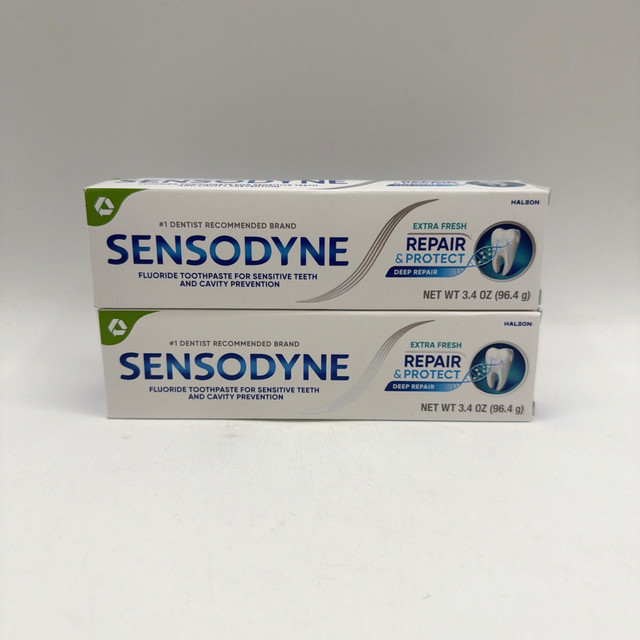
Sensodyne Repair and Protect
The variant built around a calcium-sodium-phosphosilicate technology that forms a mineral-like layer over exposed dentine. For genuine cold sensitivity it is among the more effective over-the-counter options, and the same remineralising idea has been studied specifically in orthodontic patients for white spot prevention. Worth choosing if your sensitivity is real and persistent rather than the ache that follows an adjustment. Give it a couple of weeks of consistent twice-daily use before judging.
- Calcium-sodium-phosphosilicate remineralising technology
- Fluoride included
- Twice-daily use
- Builds effect over weeks
- Among the more effective over-the-counter desensitisers
- The remineralising mechanism is relevant around brackets
- Effect builds and persists with continued use
- Needs weeks of consistent use to work
- Costs more than basic fluoride toothpaste
Sensodyne Extra Fresh or Daily Care
The straightforward potassium-nitrate variants, and the cheapest route into the range. Potassium nitrate works by calming the nerve response rather than sealing the tubules, which means it needs consistent twice-daily use and stops working if you stop. For someone whose sensitivity is mild, this does the job at a lower price than the specialist formulations. Check that whichever you buy contains fluoride — the vast majority do, but the packaging leads with sensitivity rather than the thing that protects your enamel.
- Potassium nitrate desensitising agent
- Fluoride included
- Several flavour options
- Lowest-priced Sensodyne variants
- Cheapest way into the range
- Effective for mild to moderate sensitivity
- Widely stocked everywhere
- Effect stops when you stop using it
- Less enamel-focused than Pronamel
High-Fluoride Prescription Toothpaste
The genuinely evidence-led option for brace wearers at high risk of white spots, and one to ask your orthodontist about rather than buy off a shelf. Prescription-strength fluoride toothpastes contain several times the fluoride of an ordinary tube, and high-fluoride dentifrice has been studied specifically for demineralisation next to orthodontic brackets. Availability varies by country — prescription in some, pharmacy-counter in others. If your orthodontist has mentioned early white marks, this is the conversation to have.
- Several times the fluoride of standard toothpaste
- Specifically studied around orthodontic brackets
- Prescription or pharmacy-only in most countries
- Usually a nightly application
- The strongest evidence base for preventing white spots
- Targeted at the real risk of fixed braces
- Often only needed for the duration of treatment
- Requires a dentist or orthodontist to supply or prescribe
- Not suitable for young children — follow professional advice
Fluoride Mouth Rinse
The easiest addition to a routine and a useful one, because a rinse reaches places a brush around brackets cannot. A daily fluoride rinse used at a different time from brushing — not immediately after, or you simply wash the toothpaste away — gives another exposure of fluoride to the enamel around each bracket. Choose an alcohol-free formulation, since alcohol dries the mouth and reduced saliva is itself a risk factor for demineralisation.
- Daily-use fluoride rinse
- Alcohol-free formulations available
- Reaches areas a brush cannot
- Some include additional remineralising agents
- Extra fluoride exposure with almost no effort
- Reaches around brackets and under wires
- Cheap per day
- Using it straight after brushing washes the toothpaste away
- Alcohol-containing rinses dry the mouth

Orthodontic Toothbrush with a V-Trim Head
A brush whose bristles are cut into a V-shaped channel so the outer rows reach above and below the bracket while the shorter centre rows pass over the wire. It genuinely gets closer to the bracket margin than a flat-trim brush, and the bracket margin is exactly where the white spots form. Soft bristles only — the enamel around a bracket is already under stress and hard bristles plus a firm hand cause their own damage. Replace it more often than usual, since brackets shred bristles.
- V-shaped bristle trim for bracket and wire
- Soft bristles
- Compact head for access
- Manual and electric brush head versions
- Reaches the bracket margin where damage starts
- Available as electric brush heads too
- Cheap
- Wears out much faster than a normal brush
- No substitute for interdental cleaning

Interdental Brushes in Assorted Sizes
The single most useful cleaning tool for fixed braces, and the one that reaches where a toothbrush structurally cannot — under the archwire and between brackets. Buy an assorted pack first and find the sizes that fit your gaps, since a brush that is too small does nothing and one that is too large hurts and damages the gum. Used nightly, these do more to prevent decalcification than any toothpaste choice. Take them everywhere; they are the tool you will actually use.
- Fine wire brushes in several diameters
- Assorted packs to find your sizes
- Angled and straight handles
- Travel cases available
- Reaches under the archwire, which brushing cannot
- Probably the highest-impact item in this whole list
- Cheap and quick once you find your sizes
- Wrong size does nothing or damages the gum
- Wires bend and need replacing regularly

Water Flosser
The device that makes cleaning around fixed braces realistically achievable. Threading floss under an archwire at every gap, every night, is something very few people sustain for two years — and the cleaning that does not happen is the cleaning that causes the problem. A water flosser with an orthodontic tip flushes debris from around brackets in a couple of minutes. It supplements rather than replaces brushing and interdental brushes, but it is the addition most likely to actually be used.
- Pulsed water jet with adjustable pressure
- Orthodontic tip designed for brackets
- Countertop and cordless versions
- Reservoir sized for a full clean
- Far more likely to be used consistently than threading floss
- Orthodontic tips are designed for exactly this
- Noticeably helps gum inflammation around brackets
- Bulky on a bathroom counter, and it needs a socket
- Does not replace mechanical cleaning at the bracket margin
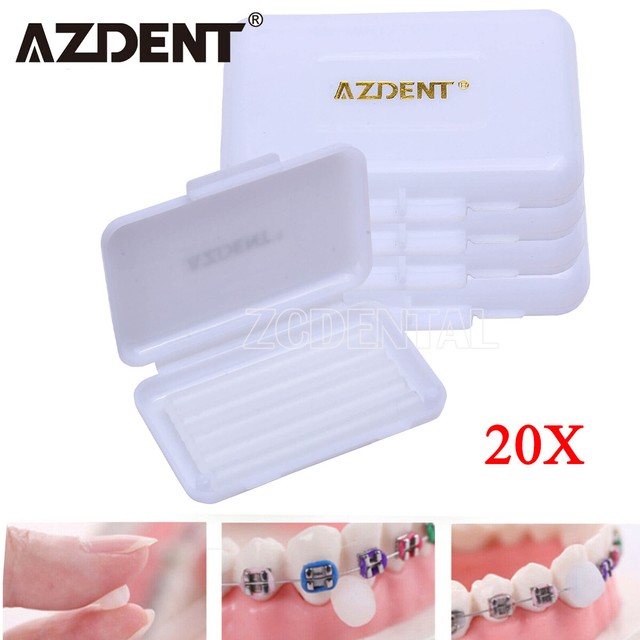
Orthodontic Wax
Not a toothpaste and nothing to do with sensitivity, but it addresses the other pain braces cause — a bracket corner or a wire end rubbing the inside of a cheek or lip into an ulcer. A pinch of wax warmed between the fingers and pressed over the offending piece gives the tissue time to toughen up. Keep some in a bag, a desk and a car; the moment you need it is never the moment you are near the bathroom. A wire genuinely poking out needs your orthodontist, not more wax.
- Soft dental wax in small cases
- Unflavoured and flavoured varieties
- Multipacks for keeping spares around
- Safe if a small amount is swallowed
- Immediate relief from bracket rubbing
- Lets the cheek lining toughen up
- Very cheap — buy several
- Falls off when eating and needs reapplying
- A protruding wire needs an orthodontist, not wax
Disclosing Tablets
The item that shows you what you are actually missing. A chewable dye tablet stains plaque a bright colour, so after brushing you can see exactly where it is still sitting — and around brackets the answer is almost always the gum margin and the corners. It is genuinely humbling, and it is the fastest way to improve technique, which matters far more than which tube you bought. Use one once a week during the first month of braces and your brushing will change permanently.
- Chewable tablets that stain plaque
- Two-tone versions distinguish new and old plaque
- Sugar-free formulations
- Packs of 12 to 60
- Shows exactly where your technique is failing
- Improves brushing more than any product choice
- Cheap and effective for children too
- Temporarily stains lips and tongue
- Can stain a sink or clothing if you are careless
Buying tips
- Sensodyne does not help with post-adjustment soreness. That ache comes from the periodontal ligament around the root being inflamed as the tooth moves through bone. Nothing applied to the enamel can reach it. Soft food, cool water and a few days are what help — and if it is severe or lasting, tell your orthodontist rather than changing toothpaste.
- The real risk of fixed braces is decalcification, not sensitivity. Brackets trap plaque, and studies put white spot lesions in roughly 25 to 46 per cent of orthodontic patients. Those marks are permanent enamel damage and they are revealed the day the braces come off. Fluoride is the main protective agent, so that is what your toothpaste choice should be about.
- Never use whitening toothpaste with fixed braces. It only reaches exposed enamel, so the patch under each bracket stays its original shade and you get a two-tone tooth when they come off. Save any whitening for after treatment, and ask your orthodontist when the enamel has settled enough for it.
- Ask about high-fluoride toothpaste if you are high risk. Prescription-strength products contain several times the fluoride of an ordinary tube and have been studied specifically for demineralisation next to brackets. If your orthodontist has already spotted early white marks, that is the conversation to have — it is far more effective than switching between over-the-counter tubes.
- Do not rinse with water straight after brushing. Spit out the excess and leave it. Rinsing washes away the fluoride before it has had time to act on the enamel, which undoes much of the point of using a fluoride toothpaste at all. The same applies to a fluoride mouthwash immediately after brushing — use it at a separate time of day.
- Interdental brushes matter more than the toothpaste. They reach under the archwire and between brackets, which a toothbrush structurally cannot. Buy an assorted pack, find your sizes, and use them nightly. This is very probably the highest-impact habit available to anyone wearing fixed braces.
- Use disclosing tablets in the first month. They stain the plaque you missed, and around brackets the answer is nearly always the gum margin and the bracket corners. Seeing it changes your technique permanently, and technique matters far more than which tube you bought. Once a week for a month is enough.
- Ask your orthodontist before changing anything. They can see your enamel, know your risk level and know what stage your treatment is at. This article describes the categories and the reasoning; it is not advice for your specific mouth, and a two-minute question at your next appointment is worth more than any amount of reading.
As an Amazon Associate and eBay Partner, toptenpick.com earns from qualifying purchases. Prices and availability are subject to change.