

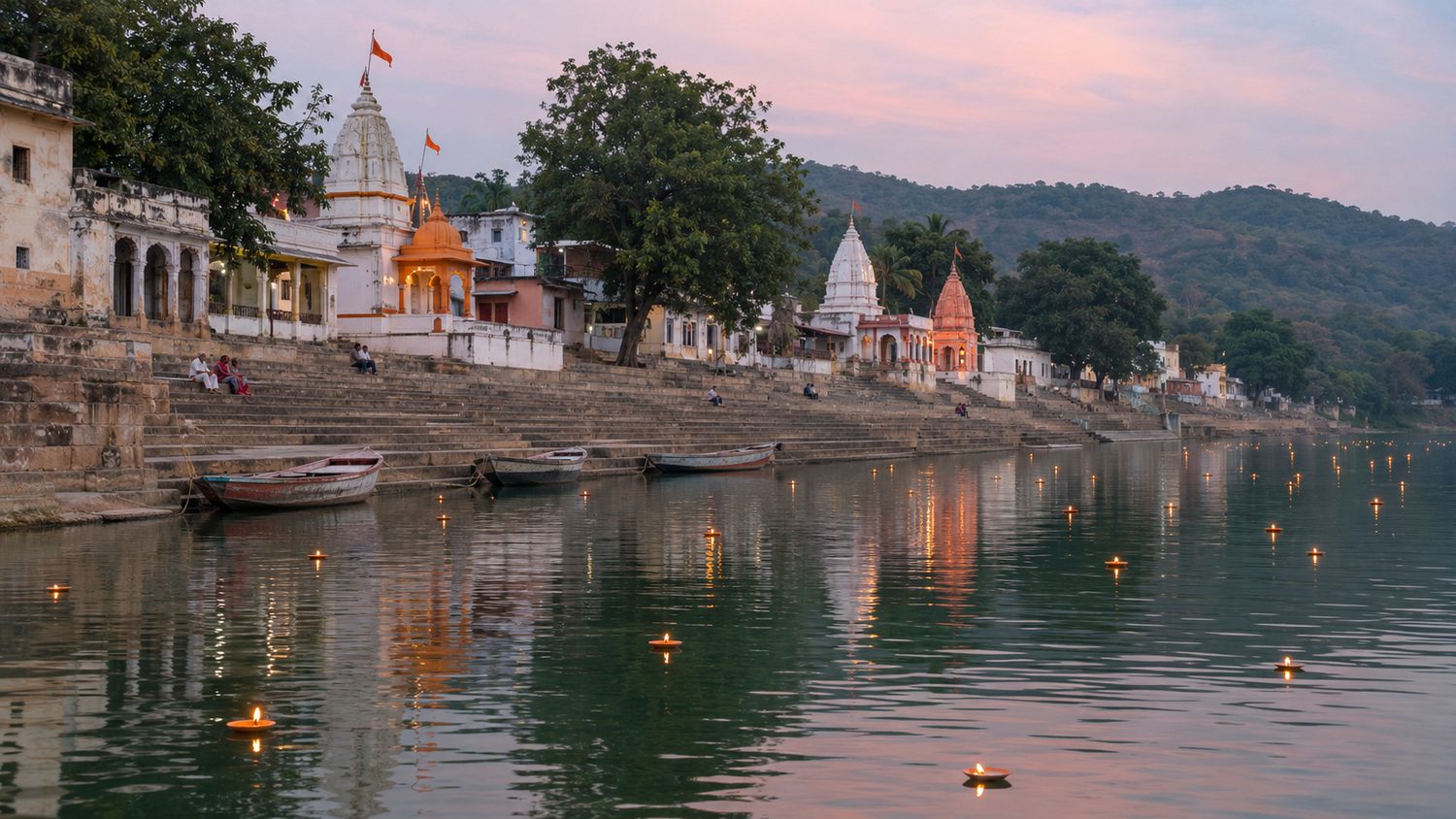
The best time to visit Chitrakoot is winter, from October to March, and the sweet spot is November to February, when days are clear and mild enough to walk the Kamadgiri parikrama in comfort. Summer is fierce, and the monsoon brings the waterfalls to life but makes paths slippery. The other thing that decides your trip is the calendar: on Diwali and on every new-moon day, Chitrakoot fills with pilgrims, so choose those dates deliberately or avoid them.
Season by season
Winter (October to March): the best time
Clear skies and pleasant days make this the most comfortable time for everything Chitrakoot is known for: the walk around Kamadgiri hill, the evening aarti at Ramghat on the Mandakini, and the climb to Hanuman Dhara. Mornings and nights turn cold in December and January, so pack a warm layer for early starts. This is also the busiest season, so book a room in advance.
Summer (April to June): hot, but quiet
Chitrakoot gets very hot in summer, with peak temperatures reported as high as 47°C. Sightseeing in the middle of the day is hard work, and the long staircase to Hanuman Dhara is punishing. If summer is your only option, do the parikrama at dawn, spend the afternoon somewhere shaded (the Gupt Godavari caves stay cool), and go back out for the evening aarti. Rooms are easier to find and cheaper.
Monsoon (July to September): green and dramatic
The rains turn the Vindhya hills green and bring the waterfalls around Chitrakoot to their best. The Mandakini runs high and the ghats are atmospheric. The trade-offs are slippery stone steps, muddy forest paths and the chance of disrupted road travel after heavy rain. Go in the monsoon if scenery matters more to you than easy walking.
Festivals and crowds
- Diwali (Deepdan mela) — the biggest event of the year. Pilgrims float lamps on the Mandakini and walk the Kamadgiri parikrama, and the fair runs from Dhanteras to Bhai Dooj. Around 18 lakh people came over three days for Diwali 2026. Unforgettable, but book months ahead and expect the parikrama path to be packed.
- Amavasya (new moon) — every month, the new-moon day draws large crowds for a holy dip and the parikrama. If you want quiet darshan, check the calendar and avoid these days.
- Ram Navami — in Chaitra (March or April), Ram’s birthday is celebrated with great devotion in a town so closely tied to his exile.
Month-by-month at a glance
- November to February — best weather; plan around Amavasya if you dislike crowds.
- October and March — warm but comfortable; good shoulder months. Diwali often falls in October or November.
- April to June — very hot; mornings and evenings only.
- July to September — monsoon; best for waterfalls and greenery, worst for walking.
Planning tips
- The Kamadgiri parikrama is a loop of roughly 5 km around the sacred hill, and many pilgrims walk it barefoot. Start early, at any time of year.
- Chitrakoot spans two states. Part of it, including much of the parikrama, lies in Madhya Pradesh, and part, including Karwi, in Uttar Pradesh. Check which side your hotel is on.
- Getting there: the nearest railway station is Chitrakoot Dham (Karwi), station code CKTD, about 10 km from Kamadgiri. The nearest major airport is Prayagraj, a road trip of a few hours.
- Two days is enough for the main sights: Kamadgiri, Ramghat, Gupt Godavari, Sati Anusuya ashram, Sphatik Shila, Hanuman Dhara and Bharat Koop. Add a day in the monsoon to see the waterfalls.
- Dress for temples: modest clothing, and footwear that slips off easily.