

As an Amazon Associate and eBay Partner, toptenpick.com earns from qualifying purchases. Prices and availability are subject to change.
The number that decides this purchase is 1½ inches, and it is measured in the stud rather than on the fastener. A T1-11 fastener has to penetrate at least an inch and a half into solid framing. Work backwards from that: the panel is typically ⅜ or ⅝ inch, add any sheathing behind it, add the 1½ inches of grip, and you arrive at a minimum length. For a ⅝ panel over ½ inch sheathing that is about 2⅝ inches, which is why the commonly quoted minimums of 2 to 2½ inches assume a thin panel fixed straight to studs. Measure your own wall rather than repeating a number off a forum.
The second thing is corrosion, and it is not optional on this material. These fasteners live in an exterior wall for decades and many T1-11 panels are treated. Hot-dipped galvanised is the working standard because the coating is thicker and lasts longer than electro-galvanised. Stainless lasts longer than either and costs accordingly — and near the coast it stops being a preference: building codes in some jurisdictions require stainless within a defined distance of salt water, commonly quoted in the 15 to 50 mile range. Check your local code rather than assuming.
Now the thing that will surprise people searching for screws: T1-11 is traditionally nailed, not screwed. The standard call-out is 6d or 8d hot-dipped galvanised siding nails, and the reason is not tradition for its own sake. A nail has a small head that seats neatly in the groove, it drives fast, and it flexes slightly with seasonal movement in a large plywood panel. Screws hold better against wind uplift and are far easier to remove — genuinely useful if you expect to take a panel off — but they concentrate stress and a power driver makes it very easy to do the one thing that ruins T1-11.
That thing is over-driving. Sink the head below the face veneer and you have broken through the thin outer ply, exposed the core, and made a small funnel that collects water. The panel then delaminates from that point outward, and it does so slowly enough that you will not connect the cause to the effect. Set the clutch, drive flush, and back off anything you sink. This matters far more than which brand of screw you buy.
On spacing: fasteners go into the studs through the grooves, typically around 8 inches apart vertically, with closer spacing along the top and bottom plates and around the perimeter. And leave the specified expansion gap at panel edges — plywood moves, and a panel butted tight buckles.
| # | Product | Price | Where to buy |
|---|---|---|---|
| 1 | Hot-Dipped Galvanised Deck Screws, 2½ inch | $25–$50 | Amazon |
| 2 | Stainless Steel Exterior Screws, 305 or 316 Grade | $45–$110 | Amazon |
| 3 | 6d or 8d Hot-Dipped Galvanised Siding Nails | $20–$45 | Amazon · eBay |
| 4 | Ring-Shank Siding Nails | $25–$55 | Amazon · eBay |
| 5 | Colour-Matched Painted Head Screws | $35–$70 | Amazon |
| 6 | Impact Driver with an Adjustable Clutch | $90–$200 | Amazon · eBay |
| 7 | Depth-Setting Nose or Collated Screw Gun Attachment | $25–$120 | Amazon |
| 8 | Exterior Caulk and Flashing Tape | $20–$45 | Amazon |
| 9 | Stud Finder | $25–$60 | Amazon · eBay |
| 10 | Drywall Screws (never use these outside) | $10–$25 | Amazon |
The picks, in detail
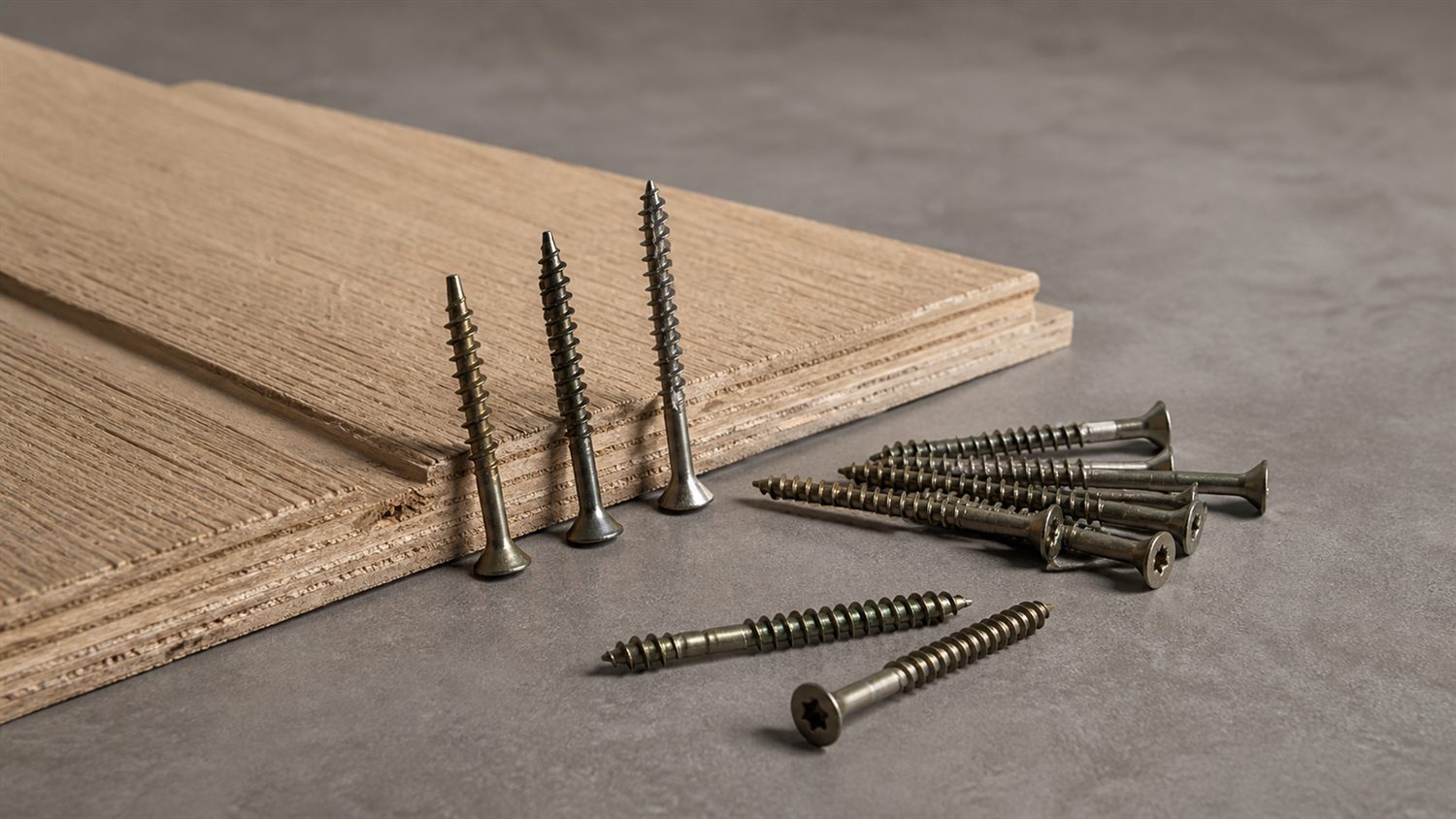
Hot-Dipped Galvanised Deck Screws, 2½ inch
The workhorse choice if you are screwing rather than nailing. Hot-dip galvanising gives a thicker, longer-lasting coating than electro-plating, which matters on an exterior wall you do not intend to revisit for twenty years. At 2½ inches they give the required 1½ inch bite through a ⅝ panel fixed directly to studs. Buy a box larger than you think — siding uses more fasteners than people estimate.
- Hot-dipped galvanised coating
- 2½ inch length for direct-to-stud fixing
- Coarse thread for framing lumber
- Bugle or flat head
- Thick coating suited to decades outdoors
- Correct length for the common wall build-up
- Cheap in bulk
- Galvanised coating chips in the driver bit and starts rusting there
- Bugle heads self-countersink, which invites over-driving
- Heads are larger than a siding nail’s
Stainless Steel Exterior Screws, 305 or 316 Grade
The right answer near the coast, where some codes require stainless within a defined distance of salt water, and a defensible one anywhere you want the wall to outlast you. Grade 305 is the common exterior stainless; 316 adds molybdenum and is the genuinely marine grade. They cost several times galvanised, they will not stain the timber, and they will still be intact when the panel is not.
- 305 or 316 stainless steel
- No coating to chip or wear
- Star or square drive
- Various lengths
- Outlasts every other option, with no coating to fail
- Required by code in some coastal zones
- No rust streaks down the siding
- Several times the price of galvanised
- Softer than hardened steel — heads cam out more easily
- 316 grade is expensive and usually unnecessary inland

6d or 8d Hot-Dipped Galvanised Siding Nails
The specified fastener for this material and worth listing first among equals. Siding nails have small heads that seat cleanly in the groove without tearing the veneer, they drive fast with a gun or a hammer, and they flex slightly as the panel moves seasonally — which a rigid screw does not. If you are installing a whole wall and do not expect to take it apart, this is the correct choice.
- 6d or 8d siding nail
- Hot-dipped galvanised
- Small head, ring or smooth shank
- Available in collated strips for nail guns
- The fastener the material is specified for
- Small head seats neatly without tearing the veneer
- Fast to install with a gun
- Very difficult to remove without damaging the panel
- Easy to over-drive with a gun set too high
- Less holding power against wind uplift than screws

Ring-Shank Siding Nails
The upgrade within the nail category, and it addresses the one real weakness of a smooth shank: withdrawal. Rings along the shaft grip the wood fibres so the nail resists being pulled back out as the panel expands, contracts and takes wind load. On an exposed elevation that is where smooth nails eventually back out and leave a row of proud heads.
- Annular rings along the shank
- Hot-dipped galvanised
- Significantly higher withdrawal resistance
- Collated for guns
- Much better resistance to backing out over time
- Handles wind load on exposed elevations
- Same small head as a plain siding nail
- Essentially impossible to remove without destroying the panel
- Slightly harder to drive fully
- Costs more than smooth shank
Colour-Matched Painted Head Screws
Worth considering if the siding is being stained rather than painted, because ordinary galvanised heads show as grey dots through a semi-transparent finish and a row of them is surprisingly visible. Colour-matched screws come with a baked finish on the head and usually a small touch-up pen. The coating is thinner than hot-dip galvanising, so check the corrosion rating rather than assuming.
- Factory-painted heads in wood tones
- Exterior-rated coating beneath the colour
- Touch-up pen usually included
- Star drive to protect the head finish
- Nearly invisible under a stained finish
- Touch-up pen covers driver marks
- Star drive reduces cam-out damage
- Coating is generally thinner than hot-dip galvanising
- Limited colour range
- More expensive per screw

Impact Driver with an Adjustable Clutch
More important to the outcome than the screws, because over-driving is the failure that ruins T1-11 and a driver without depth control makes it almost inevitable. A drill-driver with a numbered clutch, or an impact driver used carefully on a low setting, lets you stop flush rather than sinking the head through the face veneer into the core. Set it on a scrap and check the depth before starting on the wall.
- Adjustable clutch settings
- Variable-speed trigger
- Brushless motors on current models
- Belt hook for working on a ladder
- Clutch control prevents the over-driving that ruins panels
- Fast enough for a whole wall of fasteners
- Useful for everything else
- Impact drivers have less precise depth control than a clutched drill
- Another tool if you only own a drill
- Easy to override the clutch by leaning on it
Depth-Setting Nose or Collated Screw Gun Attachment
The specific answer to over-driving. A depth-setting nosepiece stops the screw at a fixed projection regardless of how hard you lean on the driver, so every fastener across a wall of siding lands at exactly the same depth. It is the difference between a wall that looks professionally done and one with a scattering of blown-through heads that will admit water for the next decade.
- Adjustable depth stop nosepiece
- Fits standard drivers or dedicated screw guns
- Collated versions feed screws automatically
- Repeatable across hundreds of fasteners
- Makes over-driving essentially impossible
- Consistent appearance across a whole wall
- Speeds up large jobs considerably
- Collated systems need matching collated screws
- Another attachment to buy for one job
- Depth needs resetting for different panel thicknesses
Exterior Caulk and Flashing Tape
Belongs on a fastener list because fasteners make holes and holes admit water. A bead of exterior-grade caulk at panel edges and around penetrations, and self-adhesive flashing tape over the horizontal joints and behind trim, is what keeps water out of the fastener holes and the panel edges. T1-11 failures are almost always water failures that started somewhere small.
- Exterior-grade paintable caulk
- Self-adhesive flashing tape for joints
- Z-flashing for horizontal panel joints
- UV-stable formulations
- Addresses the actual failure mode of this siding
- Cheap relative to a panel replacement
- Paintable so it disappears under a finish
- Caulk is not a substitute for proper flashing at horizontal joints
- Needs reapplying every several years
- Over-caulking traps water rather than excluding it

Stud Finder
Cheap and genuinely necessary, because fasteners into sheathing alone hold nothing. T1-11 grooves are usually spaced to land on standard stud centres, which gives you a starting assumption — but old houses have irregular framing, and a row of screws that missed the studs will look fine and let the panel sag within a year. Confirm rather than assume, especially on a renovation.
- Electronic or magnetic stud detection
- Edge and centre finding on better models
- Deep scan modes for thick build-ups
- Battery powered
- Prevents fasteners that grip nothing
- Cheap relative to a sagging panel
- Deep scan handles siding over sheathing
- Electronic finders struggle through thick or damp build-ups
- Magnetic finders locate existing fasteners rather than framing
- Needs calibrating on each wall
Drywall Screws (never use these outside)
Named because they are in everyone’s workshop and they look close enough. Drywall screws are hardened, brittle and — critically — have only a thin black phosphate coating that is not a corrosion barrier at all. Outdoors they rust within a season, streak the siding, and the brittle shank snaps under the shear load of a moving panel. They are an interior fastener and they fail at this job in two distinct ways.
- Hardened steel with black phosphate finish
- Bugle head, fine or coarse thread
- Very cheap and universally available
- Intended for interior drywall only
- Cheap and always to hand
- Phosphate finish is not a corrosion coating — they rust in one season
- Brittle shanks snap under shear from a moving panel
- Rust streaks run down the siding and stain any finish
Buying tips
- Work back from 1½ inches of penetration into solid framing. Add the panel thickness and any sheathing to that, and measure your own wall rather than repeating a length off a forum.
- Buy hot-dipped galvanised rather than electro-galvanised. The coating is thicker and lasts substantially longer on a wall you will not revisit for twenty years.
- Check your local code if you are near the coast. Some jurisdictions require stainless within a defined distance of salt water, commonly quoted somewhere between 15 and 50 miles.
- Consider nails rather than screws unless you want removability. The material is specified for 6d or 8d hot-dipped galvanised siding nails, whose small heads seat cleanly and which flex with seasonal movement.
- Never sink the head below the face veneer. Breaking through the thin outer ply exposes the core and creates a funnel that collects water, and the panel delaminates from there outward.
- Use a clutch or a depth-setting nosepiece, and test on a scrap first. Over-driving is the one mistake that ruins this siding and a power driver makes it easy.
- Fix into studs through the grooves, roughly 8 inches apart, with closer spacing along the plates and around the perimeter. Fasteners into sheathing alone hold nothing.
- Never use drywall screws outdoors. The black phosphate finish is not corrosion protection, they rust within a season and streak the siding, and the brittle shanks snap under shear.
As an Amazon Associate and eBay Partner, toptenpick.com earns from qualifying purchases. Prices and availability are subject to change.