

As an Amazon Associate and eBay Partner, toptenpick.com earns from qualifying purchases. Prices and availability are subject to change.
Swapping rocker arms is the one small-block Ford upgrade where the part you buy changes the geometry of everything downstream of it, and that’s the detail most buying guides skip. Rocker ratio sets how much the valve opens for a given amount of cam lobe lift — going from a 1.6:1 to a 1.7:1 rocker increases valve lift by roughly that same proportion, on the exact same camshaft. More lift moves the pushrod length requirement and the rocker tip’s sweep across the valve stem, which is why “just bolt on the stronger rocker” can end with the retainer touching the valve seal at full lift or the spring going into coil bind — problems that show up as a tick or a dead cylinder, not as extra power. Before ordering a higher ratio than you’re running now, check pushrod length and retainer-to-seal clearance at full lift; there’s no universal pushrod length for this swap because head deck height, gasket thickness and cam base circle all shift the number.
The second thing to get right before ordering is which mounting style your heads use. Small-block Ford heads split into two different rocker systems: pedestal mount, where the rocker stand is a machined boss cast into the head, and stud mount, where the head is machined and tapped for a separate screw-in stud. These aren’t a performance choice — a stud-mount rocker set simply will not bolt to pedestal-mount heads and vice versa, so the number that matters before you shop by ratio or brand is which style your cylinder heads actually carry.
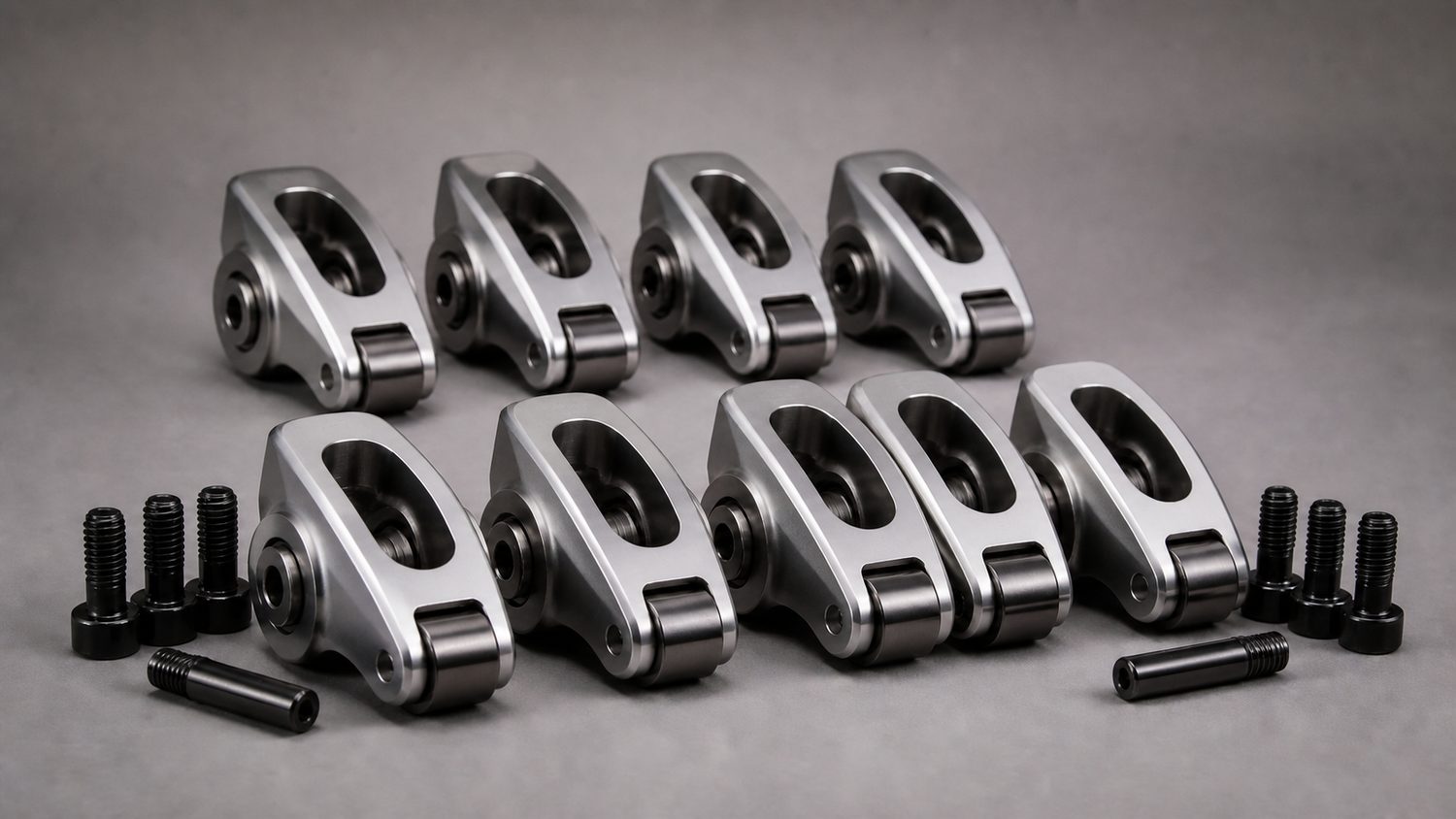
The third distinction that’s easy to gloss over: “roller rocker” describes two different products at very different price points. A full-roller rocker runs needle bearings at both the fulcrum, where it pivots, and the tip, where it touches the valve stem, cutting friction at both points. A roller-tip rocker — often a stamped-steel body — only has the roller at the valve-stem end; the pivot still rides on a plain bore. It’s a real, cheaper upgrade over a stock non-roller rocker, but it isn’t the same product as a full-roller set, and that gap is exactly the friction reduction you’re paying more for in the full-roller kits below.
The list below spans stamped-steel roller-tip economy pieces through shaft-mount race systems — match the entry to what the rest of your valvetrain (cam, springs, heads) can actually use, since none of this was installed or run on an engine here. Verify ratio, stud or pedestal pattern, and pushrod length against your own heads and cam card before ordering.
| # | Product | Price | Where to buy |
|---|---|---|---|
| 1 | Comp Cams High Energy Die-Cast Aluminum Roller Rockers (17043-16) | $238–$250 | Amazon · eBay |
| 2 | Comp Cams Ultra-Gold ARC Steel Rocker Arms (19044-16) | $375–$415 | Amazon · eBay |
| 3 | Comp Cams Ultra Pro Magnum XD Rocker Set (1833-16) | $600–$635 | Amazon |
| 4 | Crane Cams Gold Race Extruded Rocker Arms (36750-16) | $370–$390 | Amazon |
| 5 | Harland Sharp Original Series Roller Rockers | $390–$425 | Amazon |
| 6 | Scorpion Racing Products Race Series Rocker Arms (SCP1017) | $420–$430 | Amazon |
| 7 | ProForm 66876 Pedestal Mount Roller Rocker Arm Set | $250–$260 | Amazon · eBay |
| 8 | PRW Sportsman Steel Roller Tip Rocker Arms (0830201/0830202) | $115–$165 | Amazon |
| 9 | PRW Sportsman Pedestal Shaft Rocker System (3330201) | $600–$620 | Amazon |
| 10 | T&D Machine Sport Comp Shaft Rocker Kit (10020-160/160) | $1,300–$1,400 | Amazon |
The picks, in detail

Comp Cams High Energy Die-Cast Aluminum Roller Rockers (17043-16)
Comp Cams’ entry-level full-roller rocker for the 289-351W family: a die-cast aluminum body running needle bearings at both the fulcrum and the roller tip, in a 1.6:1 ratio on a 3/8″ stud. Comp rates this line for street and moderate race use rather than all-out competition — the right amount of rocker for a mild hydraulic-roller street engine that just wants the friction reduction of a real roller design over stock stamped-steel rockers.
- 1.6:1 ratio, 3/8″ stud mount
- Die-cast aluminum body
- Needle-bearing fulcrum and roller tip
- Set of 16, rated for street and moderate race use
- Full roller design cuts friction at both the pivot and the valve tip vs. stock rockers
- Die-cast aluminum keeps valvetrain weight down
- Budget-friendly entry into full-roller performance
- Die-cast body is less rigid under high spring pressure than a forged or steel rocker
- 3/8″ stud only — won’t fit heads machined for 7/16″ studs
- Still requires a pushrod-length check with any cam change

Comp Cams Ultra-Gold ARC Steel Rocker Arms (19044-16)
A step up in material from the die-cast High Energy set: a steel rocker body on a 7/16″ stud, rated to handle up to 700 lbs of spring pressure at the same 1.6:1 ratio. That stud size and spring-pressure rating make it the pick for a head that’s already been machined for 7/16″ studs and a cam with real spring pressure behind it, not a stock hydraulic flat-tappet combination.
- 1.6:1 ratio, 7/16″ stud mount
- Steel rocker body
- Rated to 700 lbs of spring pressure
- Needle-bearing trunion and roller tip
- Handles far more spring pressure than the aluminum High Energy set
- 7/16″ stud is the stronger stud size where heads support it
- Still a full-roller design, not roller-tip only
- Needs 7/16″-stud heads or a stud upgrade — many stock Windsor heads aren’t machined for it
- Costs roughly 60% more than the aluminum 1.6:1 High Energy set
- Heavier than an aluminum rocker, which matters at high rpm
Comp Cams Ultra Pro Magnum XD Rocker Set (1833-16)
The 1.7:1 ratio version in Comp’s Ultra Pro Magnum XD line, built from 8650 chromoly steel with a machined billet pushrod seat insert, on a 3/8″ stud. Going to 1.7:1 pulls more lift out of the same camshaft without a cam swap — exactly the change that requires checking pushrod length and retainer clearance before installing, since the rocker geometry moves along with the extra lift.
- 1.7:1 ratio, 3/8″ stud mount
- 8650 chromoly steel body
- Machined billet pushrod seat insert
- Full roller design
- Adds real lift and duration off the same camshaft without a cam swap
- Chromoly steel handles more spring pressure than die-cast aluminum
- Keeps 3/8″ stud compatibility for heads that don’t have 7/16″ studs
- The higher ratio forces the pushrod-length and retainer-clearance check described above
- Priciest Comp Cams option on this list
- Overkill on a stock-cam engine that doesn’t need the extra lift
Crane Cams Gold Race Extruded Rocker Arms (36750-16)
Crane’s Gold Race rockers use an extruded — not die-cast — billet aluminum body with precision-ground needle bearings, in the same 1.6:1, 3/8″-stud spec as the Comp Cams High Energy set. Crane markets its Quick-Lift bearing design as good for up to 25 hp over stock pivot-ball rockers on a full valvetrain combination — a full-engine claim, not a number this part alone delivers on a stock short block.
- 1.6:1 ratio, 3/8″ stud mount
- Extruded (not die-cast) billet aluminum body
- Precision-ground needle bearings
- Set of 16
- Extruded aluminum body is stiffer than a die-cast equivalent at the same ratio
- Well-known bearing design (Crane’s Quick-Lift) with a long track record
- Direct 3/8″ stud fitment for stock studs
- Crane’s horsepower claim is for a full valvetrain combo, not this part alone on a stock engine
- Similar price to Harland Sharp or Scorpion without a clear edge over either
- 3/8″ stud limits spring-pressure headroom vs. the 7/16″ options here
Harland Sharp Original Series Roller Rockers
Harland Sharp has built roller rockers for circle track and street performance longer than most names on this list, and the Original Series is its standard 3/8″-stud, 1.6:1 full-roller offering for small-block Ford: cage-guided needle bearings at the fulcrum, an anodized aluminum body, sold as a set of 16. A straightforward, well-proven full-roller upgrade without a shaft-mount system’s cost or install complexity.
- 1.60:1 ratio, 3/8″ stud mount
- Anodized aluminum body
- Cage-guided needle bearings
- Full roller, set of 16
- One of the longest-established names in roller rocker manufacturing
- Full needle-bearing design at both pivot and tip
- Anodized finish resists wear
- 3/8″ stud version caps usable spring pressure below the 7/16″ options on this list
- No ratio choice beyond 1.60 in this specific configuration
- Among the pricier 3/8″-stud options here despite no ratio advantage over Comp Cams or Crane
Scorpion Racing Products Race Series Rocker Arms (SCP1017)
Scorpion’s SCP1017 is rated to 0.950 inches of lift and 950 lbs of open spring pressure — more headroom than the Comp Cams or Crane 3/8″-stud sets above — with extra clearance built in around the retainer and spring for higher-lift cams. CNC-machined and micro-polished for consistency across the set, in the same 1.6:1 ratio and 3/8″ stud as the other aluminum options here.
- 1.6:1 ratio, 3/8″ stud mount
- Rated to 0.950″ lift and 950 lbs open spring pressure
- CNC-machined, micro-polished aluminum
- Extra retainer and spring clearance built in
- Highest rated lift and spring-pressure headroom of the 3/8″-stud aluminum rockers here
- Extra retainer/spring clearance built in for higher-lift cams
- CNC-machined and polished for consistency across the set
- Most expensive 3/8″-stud aluminum option here despite sharing the 1.6 ratio with cheaper sets
- That lift and spring-pressure headroom is wasted on a mild stock-cam engine
- Still requires checking your pedestal/stud pattern matches before ordering

ProForm 66876 Pedestal Mount Roller Rocker Arm Set
The only pedestal-mount rocker on this list, for small-block Ford aluminum heads that were never machined for a screw-in stud — buying any of the stud-mount rockers above for these heads simply won’t work. The set mixes ratios, 8 at 1.6:1 and 8 at 1.7:1, on a 5/16″ pedestal bolt pattern, with full needle-bearing fulcrums and roller tips, pedestals and mounting bolts included.
- 5/16″ pedestal mount
- Mixed set: 8 rockers at 1.6:1, 8 at 1.7:1
- Extruded aluminum with full needle-bearing fulcrum and roller tip
- Pedestals and mounting bolts included
- Only pedestal-mount full-roller set on this list for heads that won’t take a stud
- Mixed 1.6/1.7 ratio lets intake and exhaust run different lift without two kits
- Pedestals and mounting bolts included, not sold separately
- Pedestal mount is inherently less rigid under load than a stud-mount setup
- Running two ratios in one set means checking pushrod length separately for each side
- Limited to the specific pedestal-mount head castings it’s designed for
PRW Sportsman Steel Roller Tip Rocker Arms (0830201/0830202)
A 4340 chromoly steel rocker for 1962-2001 Ford 289-351W, available in 1.6:1 or 1.7:1 on a 3/8″ stud — but this is a roller-tip design, not a full roller: the roller bearing is at the valve stem end only, and the pivot still runs on a plain bore. It’s a real, inexpensive upgrade over a stock non-roller rocker, priced well below every full-roller set on this list.
- 1.6:1 or 1.7:1 ratio, 3/8″ stud mount
- 4340 chromoly steel body
- Roller tip only — plain-bore pivot, not a full roller
- Self-aligning design for 1962-2001 Ford 289-351W
- Cheapest way to add roller-tip friction reduction over a stock non-roller rocker
- Chromoly steel body is stronger than a stamped-steel equivalent
- Self-aligning design tolerates some stud-to-rocker misalignment
- Roller-tip only — the pivot still runs on a plain bore, unlike the full-roller sets above
- Heavier than the aluminum full-roller options on this list
- The lowest-spec pick here for a genuinely built or high-spring-pressure engine
PRW Sportsman Pedestal Shaft Rocker System (3330201)
A shaft-mount system for small-block Ford 289-351W at 1.60:1, with steel pedestal stands tying all eight rockers on a head to a common shaft instead of mounting each one individually on its own stud or pedestal. That shared shaft controls rocker deflection and geometry far better under heavy spring load than stud or pedestal rockers, with adjustable cup-style lash instead of shims.
- 1.60:1 ratio, shaft-mount system
- Steel pedestal stands, ground steel rocker shafts
- Adjustable cup-style valve lash, no shims required
- Full kit for both heads (16 rockers)
- Shared shaft controls rocker deflection and geometry better than individual stud/pedestal rockers
- Adjustable lash without shims
- A genuine step up from stud or pedestal rockers, priced well under race shaft systems
- Roughly double the cost of the stud-mount aluminum sets above for the same 1.60 ratio
- Installation is more involved — a different mounting system, not a drop-in swap
- Still needs the same pushrod-length check as any ratio-matched rocker
T&D Machine Sport Comp Shaft Rocker Kit (10020-160/160)
T&D Machine has built racing shaft rocker systems since 1975, and this SBF kit is purpose-built rather than adapted: 4130 steel shafts, deep-case hardened, in 2024 aluminum rocker bodies, with an internal oil passage running from the pushrod cup to the shaft bearings and out to the roller tip. It’s the rigidity and oiling ceiling of this list, priced closer to a cylinder head than a rocker arm set.
- 1.60:1 / 1.60:1 ratio, shaft-mount system
- 4130 steel shafts, deep-case hardened
- 2024 aluminum rocker bodies
- Internal oil passage to the shaft bearings and roller tip
- Purpose-built race shaft system from a manufacturer building these since 1975
- Internal oiling to the shaft bearings and roller tip beyond what stud/pedestal kits offer
- The rocker geometry and rigidity ceiling of this list
- By far the most expensive option here, priced closer to a cylinder head than a rocker set
- Genuinely wasted on a stock or mild street 302/351W — this is for an already-built engine
- Requires more setup knowledge (shaft geometry, oiling) than a bolt-on stud or pedestal kit
Buying tips
- Identify whether your cylinder heads use pedestal-mount or stud-mount rocker arms before shopping by ratio or brand — the two mounting styles are not interchangeable.
- Measure pushrod length with an adjustable checking pushrod any time you change rocker ratio, cam, or head gasket thickness; there’s no single correct length for “a small-block Ford.”
- Check valve-to-retainer and retainer-to-seal clearance at full lift after installing a higher-ratio rocker, since more ratio means more retainer travel on the same cam.
- Decide between full-roller and roller-tip-only before comparing prices — a roller-tip rocker is a real upgrade over stock but doesn’t cut friction at the pivot the way a full-roller design does.
- Match stud diameter (3/8″ vs. 7/16″) to what your heads are actually machined for, or budget for a stud upgrade if you want the stronger 7/16″ size.
- Reserve shaft-mount systems for engines already running the spring pressure and lift that justify the extra rigidity and cost — they’re wasted on a stock-cam engine.
- Re-check pushrod length again after any rocker swap even if the ratio stayed the same, since rocker body geometry differs between brands.
- Verify maximum rated spring pressure and lift on any rocker set against your actual cam card and springs, not just against the ratio number.
As an Amazon Associate and eBay Partner, toptenpick.com earns from qualifying purchases. Prices and availability are subject to change.