

As an Amazon Associate and eBay Partner, toptenpick.com earns from qualifying purchases. Prices and availability are subject to change.
A flybarless unit’s actual job is simple to state: replace the mechanical flybar with sensors and software that do the same stabilizing work electronically. On paper, that means any of them should be able to hover a helicopter. What actually separates a smooth first conversion from a frustrating one rarely shows up on a spec sheet — it’s the setup wizard, the tuning documentation, and how much of the community has already solved your specific helicopter’s quirks, because you will be adjusting gains after you feel it fly, not before.
The trap that catches the most buyers: a flybarless unit needs fast digital servos, full stop. Analog servos — even ones with matching torque and speed numbers on the spec sheet — respond too slowly to the corrections a flybarless system issues dozens of times a second, and their deadband is enough to make the helicopter feel mushy and imprecise no matter how well the unit is tuned. Pilots converting an older flybar helicopter often blame the new flybarless unit for a problem that’s actually sitting in their old servos. Budget for servos as part of this purchase if you’re not already running fast digitals.
Protocol compatibility is the second thing that quietly turns into an extra purchase. Some units expect plain PWM, one wire per channel; others expect a serial bus — SBus, CRSF, EX Bus — that carries every channel over a single wire, and not every unit supports every bus. Check your transmitter and receiver against the specific unit’s supported protocol list before ordering, or you may end up needing a new receiver to go with your new flybarless unit.
There’s also a real split between integrated units, which bundle the flybarless controller, ESC and receiver into one box and install with fewer wires, and standalone units, which separate those roles and give more flexibility if you already own a receiver you like. Neither is objectively better — it depends on whether you’re building from scratch or upgrading one component on a helicopter that already works.
None of the ten units below have been installed or flown by this site. They’re drawn from manufacturer documentation, long-running enthusiast comparisons, and forum consensus among pilots who fly these day to day, and the list spans a genuine range — from a wizard-driven unit built for a first conversion to an open-source budget option that expects you to already know what you’re tuning.
| # | Product | Price | Where to buy |
|---|---|---|---|
| 1 | MSH Brain2 (iKON2) | $170–$300 | Amazon · eBay |
| 2 | Bavarian Demon 3X | $190–$220 | Amazon · eBay |
| 3 | Bavarian Demon Axon | $330–$370 | Amazon · eBay |
| 4 | Futaba CGY755 | $330–$370 + GPB-1 box | Amazon · eBay |
| 5 | Futaba CGY760R | $430–$470 + GPB-1 box | Amazon · eBay |
| 6 | Mikado VBar NEO | $160–$220 | Amazon · eBay |
| 7 | BeastX Microbeast Plus | $150–$190 | Amazon · eBay |
| 8 | Spektrum FC6250HX | $180–$220 | Amazon · eBay |
| 9 | Spirit 2 | $230–$270 | Amazon |
| 10 | RadioMaster NEXUS | $60–$90 | Amazon · eBay |
The picks, in detail
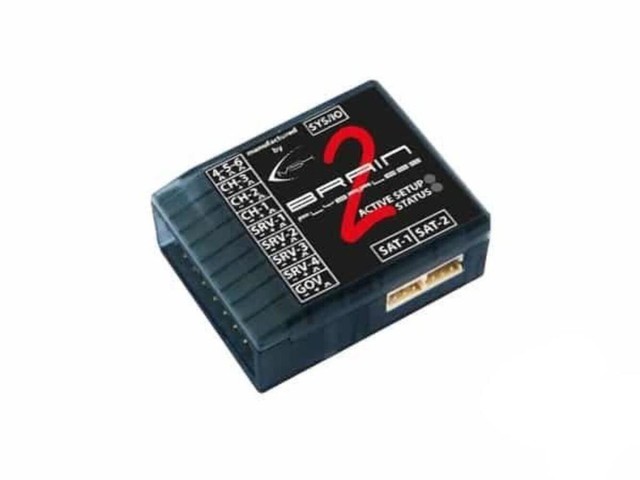
MSH Brain2 (iKON2)
Widely cited for having one of the best setup wizards in the category — it walks through servo identification and basic tuning on-screen rather than leaving you to guess at menu settings, and it logs vibration data after a flight so you can diagnose a rough hover instead of re-tuning blind. A strong first flybarless unit for someone converting their first helicopter.
- On-unit setup wizard with guided servo ID
- Post-flight vibration and flight-log analysis
- Supports Futaba/FrSky SBus, Spektrum DSM, Jeti EX Bus
- Governor support for electric and nitro setups
- Setup wizard genuinely shortens the learning curve
- Flight-log diagnostics help catch a bad tune
- Wide protocol compatibility
- Still needs fast digital servos — won’t fix an underpowered servo
- Standalone unit, so more wiring than an integrated combo
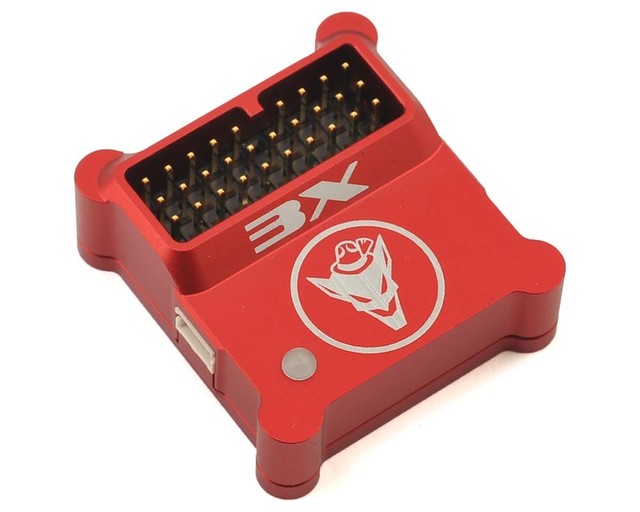
Bavarian Demon 3X
A long-running favorite among pilots who fly turbines and larger nitro helis specifically because it filters ultrasonic engine vibration that trips up cheaper sensors, and several reviewers single it out for how it actually feels in the air rather than just on a bench. USB setup over a standard 3-pin servo cable keeps the tuning workflow simple.
- Vibration filtering tuned for turbine and nitro engines
- USB configuration via standard servo cable
- Adjustable gain and expo profiles
- Compact form factor
- Strong reputation for flight feel, not just specs
- Handles turbine vibration better than budget units
- Simple USB-based tuning
- Being phased out in favor of the newer Axon
- Fewer beginner tutorials than the more mainstream units

Bavarian Demon Axon
The 32-bit successor to the 3X, built with the same turbine-friendly filtering plus a rescue mode that can level the helicopter from an unusual attitude, and full governor support for RPM head-speed helis. Aimed at pilots who already know what they want from a flybarless unit and are willing to pay for the newest sensor generation.
- 32-bit processing with vibration analysis
- Rescue and bailout mode
- Full RPM governor support
- Turbine-friendly filtering inherited from the 3X
- Newest sensor generation in the Bavarian Demon line
- Rescue mode adds a real safety margin
- Strong governor support for nitro and turbine
- One of the pricier units on this list
- Overkill feature set for a first flybarless conversion

Futaba CGY755
Futaba’s flagship flybarless gyro, rated by more than one reviewer as one of the best flybarless systems available, with three-axis sensing and full governor support across nitro, gas, electric and turbine helis. The catch buyers miss: tuning it requires a separate GPB-1 programming box sold apart from the unit, so the sticker price isn’t the full cost of getting it running.
- 3-axis flybarless sensing with governor
- Compatible with nitro, gas, electric and turbine helis
- Requires a separate GPB-1 programming box
- Futaba S.Bus2 telemetry support
- Excellent reputation for precision and reliability
- Works across virtually every power type
- Strong governor implementation
- Programming box sold separately — factor it into the real price
- Setup is less beginner-guided than the wizard-driven units

Futaba CGY760R
Effectively the CGY755 with a receiver built in — the same three-axis sensing and governor support, but it removes the separate-receiver step that trips people up on the 755, at the cost of locking you into Futaba’s T-FHSS and FASSTest protocols. Worth the premium mainly if you’re already committed to a Futaba radio.
- Integrated T-FHSS/FASSTest receiver
- 3-axis flybarless sensing with governor
- Compatible with nitro, gas, electric and turbine helis
- Requires the same GPB-1 programming box as the CGY755
- One less separate component to wire in
- Same proven sensing as the CGY755
- Strong governor for RPM head-speed setups
- Only useful if you’re already on Futaba radios
- Most expensive unit on this list

Mikado VBar NEO
The current generation of the system many serious 3D and scale pilots treat as the reference standard for tuning depth — it replaces both the older VBar Mini and VBar Silverline with one sensor platform. Programming is done through Mikado’s own VControl radios or PC software, a genuinely deep toolset but a steeper first encounter than a wizard-driven unit.
- Successor to VBar Mini and VBar Silverline
- Deep, granular tuning parameters
- Programs via Mikado VControl radio or PC software
- Broad receiver protocol support
- Extremely well regarded for tuning depth and precision
- Long track record in competitive 3D flying
- Active community and firmware support
- Steeper learning curve than wizard-based units
- Best experience assumes a Mikado VControl radio

BeastX Microbeast Plus
Often recommended as the best flybarless unit for a genuine first conversion — programming happens through LED indicators and button presses directly on the unit, so there’s no separate app or programming box to lose track of. It’s compact enough to fit helicopters where wiring space is tight, and it comes in sizes for almost any class.
- On-unit LED and button programming — no separate app required
- Compatible with Spektrum DSM2/DSMX and Futaba S.Bus
- Compact form factor
- Available in Plus, Ultra and Nano variants for different heli sizes
- Simplest programming interface on this list
- Small enough for tight installs
- Available in a size for almost any heli class
- Fewer advanced tuning parameters than VBar or Brain2
- LED-code programming is fiddly compared to a screen or app

Spektrum FC6250HX
Spektrum’s own flybarless controller, built around the AS3X and SAFE stabilization tech familiar from their ready-to-fly helis, which makes it a natural fit if you’re stepping up from a Spektrum RTF model and want to keep the same radio and receiver ecosystem. It covers everything from 3D to scale flying on one unit.
- AS3X and SAFE stabilization technology
- DSM2/DSMX and SRXL2 receiver protocol support
- Profiles for 3D, F3C, scale and beginner flying styles
- Built by the same company behind many RTF heli receivers
- Straightforward for pilots already in the Spektrum ecosystem
- Flexible across flying styles
- Reliable stabilization tech with a long track record
- Best matched to Spektrum radios and receivers
- Less standalone-forum documentation than VBar or Brain2
Spirit 2
The newest entrant here, built around a 12-axis sensor and a genuine setup wizard in its companion software, with Bluetooth or Wi-Fi tuning from a phone as an option (the wireless module is sold separately). It also supports a rescue and bailout function, and the same hardware can be reflashed with alternate firmware to fly fixed-wing aircraft.
- 12-axis sensor package
- Setup wizard in companion software (Windows, macOS, Linux, Android, iOS)
- Optional Bluetooth/Wi-Fi tuning module
- Rescue and bailout mode with optional GPS add-on
- Guided setup wizard lowers the learning curve
- Wireless tuning option is genuinely convenient once installed
- Cross-platform companion software
- Wireless tuning module is an extra purchase
- Newer to the market than VBar or Microbeast, so less long-term track record

RadioMaster NEXUS
The budget outlier on this list — built around the open-source RotorFlight firmware rather than a manufacturer’s closed system, in a CNC aluminum case with a modern gyro chip, at a fraction of the other units’ price. The trade is that RotorFlight expects you to understand what you’re tuning; it doesn’t hold your hand the way a wizard-driven unit does.
- Runs open-source RotorFlight firmware
- CNC aluminum case
- TDK IIM-42688 gyro sensor
- Supports DSM, SBus, CRSF and ELRS receiver protocols
- Lowest price on this list by a wide margin
- Open-source firmware is actively developed and free to update
- Broad receiver protocol support
- No guided setup wizard — expects tuning knowledge
- Smaller support ecosystem than the established commercial units
Buying tips
- Check your existing cyclic and tail servos before buying — flybarless units need fast digital servos, and analog servos will make even a correctly tuned unit feel imprecise.
- Confirm your receiver’s output protocol (PWM, SBus, CRSF, EX Bus) is on the unit’s supported list before ordering, or budget for a new receiver too.
- If you’re new to flybarless conversions, prioritize a unit with an on-device or app-based setup wizard, like the Brain2, Spirit 2 or Microbeast, over one that expects manual gain tuning from a printed manual.
- Units that require a separate programming box, like Futaba’s CGY755 and CGY760R, cost more to get running than the sticker price suggests — check for that before comparing prices.
- An integrated flybarless-plus-receiver unit installs faster and has fewer wiring points to get wrong; a standalone unit is more flexible if you already own a receiver you like.
- If you fly turbine or large nitro helis, look specifically for vibration filtering tuned for engine harmonics — sensors built for electric helis can be fooled by that vibration.
- A governor feature is only worth paying extra for if your helicopter runs a setup that actually uses one, like nitro or turbine RPM head-speed — electric collective-pitch setups usually don’t need it.
- Read the compatible-helicopter list before buying a compact unit sized for smaller helis — a 450-class unit isn’t rated for the servo loads of a 700-class machine.
As an Amazon Associate and eBay Partner, toptenpick.com earns from qualifying purchases. Prices and availability are subject to change.