

As an Amazon Associate and eBay Partner, toptenpick.com earns from qualifying purchases. Prices and availability are subject to change.
“Quilted” describes a way of building a jacket, not how warm it is. That distinction catches out more shoppers than any other in outerwear, and once you understand it the whole category becomes much easier to navigate.
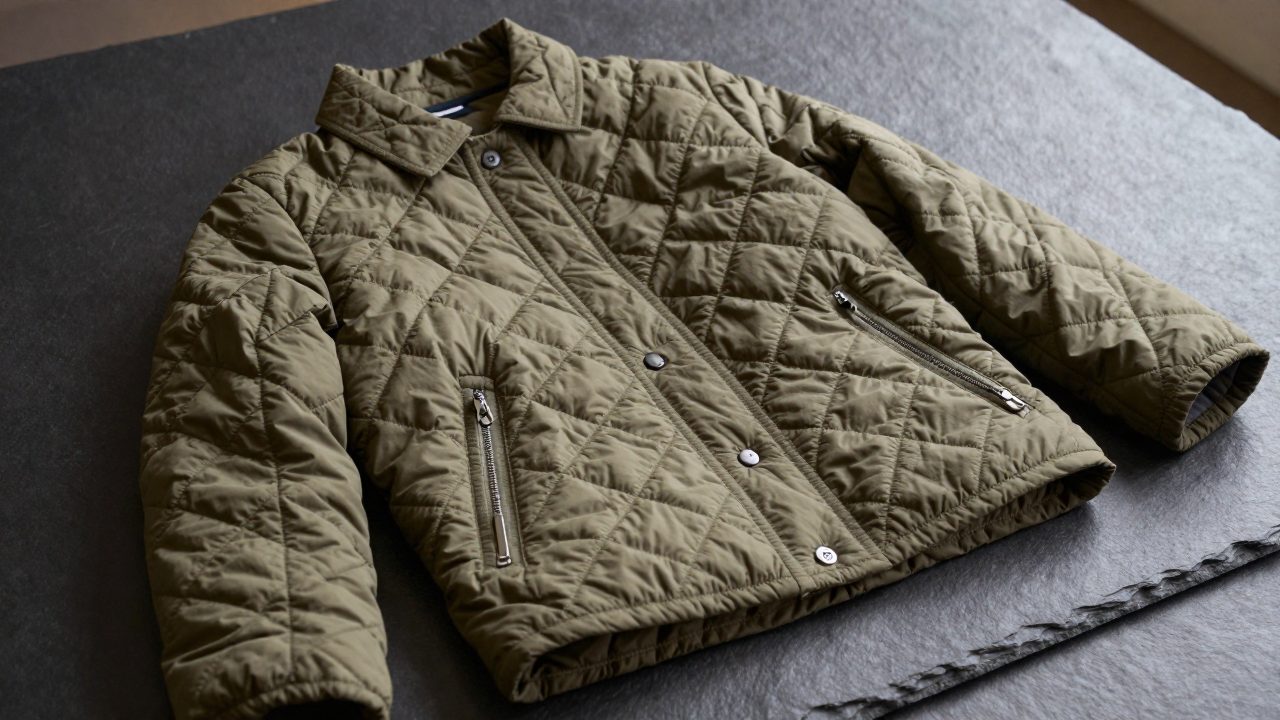
Quilting exists for one engineering reason: loose insulation migrates. Down, feathers and loose synthetic fill will settle to the bottom of a garment with wear and gravity, leaving you with a cold chest and a lumpy hem. Stitching the outer shell to the lining at intervals creates sealed compartments that hold the fill where it was put. The diamonds, boxes and channels you see are structural, not decorative.
Which leads to the thing worth knowing before you spend anything. A great many fashion quilted jackets have almost no fill in them at all. The quilting is stitched through two layers of shell fabric with a whisper of wadding between, purely for the look, and the garment is a mid-season style piece — perfectly nice, and almost no warmer than a shirt. Meanwhile a genuinely warm jacket may show very little quilting, because modern baffle construction and sheet insulation hold fill in place without the stitching being visible from outside.
So compare the number, not the pattern. Down is rated by fill power — 550 is decent, 700 is good, 800-plus is excellent — which measures how much volume an ounce of down occupies, and therefore how much air it traps per gram of weight. Synthetic fill is rated by weight in grams per square metre, and 40 gsm is a light mid-season jacket while 100 to 200 gsm is genuine winter warmth. A listing that gives neither number is telling you something by omission.
One more piece of the same puzzle: tighter quilting is slightly colder. Every stitch line is a place where the outer and inner layers touch and the insulation is compressed to nothing, so a cold bridge runs along it. Small, dense diamonds have more cold bridging than large boxes. It is a modest effect and it is real, and it is why serious winter jackets use large baffles.
Ten picks below, covering every point on the range from style piece to genuine winter coat.
| # | Product | Price | Where to buy |
|---|---|---|---|
| 1 | Lightweight Packable Down Jacket | $90-$280 | Amazon · eBay |
| 2 | Diamond-Quilted Country Jacket | $90-$300 | Amazon · eBay |
| 3 | Synthetic-Insulated Quilted Jacket (60-100 gsm) | $60-$180 | Amazon |
| 4 | Longline Quilted Coat | $100-$350 | Amazon · eBay |
| 5 | Cropped or Boxy Quilted Jacket | $50-$150 | Amazon · eBay |
| 6 | Quilted Gilet or Body Warmer | $50-$160 | Amazon · eBay |
| 7 | Waterproof Quilted Parka with a Membrane | $140-$400 | Amazon |
| 8 | Reversible Quilted Jacket | $70-$200 | Amazon · eBay |
| 9 | Down Wash and Reproofing Treatment | $15-$35 | Amazon |
| 10 | Dryer Balls for Restoring Loft | $10-$25 | Amazon |
The picks, in detail

Lightweight Packable Down Jacket
The most useful quilted jacket most people can own. Real down at 600 to 800 fill power, small baffles, and light enough to stuff into its own pocket and live in a bag permanently. The warmth-to-weight ratio of good down is still unmatched by anything synthetic, which is why this format survives every trend. Check the fill power and the fill weight, both — a jacket can have excellent 800-fill down and hardly any of it, which makes it very light and not very warm.
- 600-800 fill power down
- Packs into its own pocket or a stuff sack
- Lightweight ripstop shell
- Elasticated cuffs and hem
- Best warmth for its weight and packed size of anything here
- Lives permanently in a bag without being noticed
- Layers under a shell for genuine winter use
- Down loses most of its insulation when wet
- Fine shells snag and leak feathers from small tears

Diamond-Quilted Country Jacket
The classic English countryside shape — hip length, diamond quilting, corduroy collar, press-stud front — and a style that has outlasted several decades of fashion. Honest about what it is: this is a mid-season jacket with modest wadding, designed for a cool dry day rather than genuine cold. It is shower-resistant rather than waterproof. What it does very well is look appropriate almost anywhere, which for a lot of buyers is exactly the point.
- Diamond quilting with polyester wadding
- Corduroy collar and press-stud front
- Hip length with side pockets
- Shower-resistant shell
- Timeless shape that does not date
- Appropriate in a very wide range of settings
- Comfortable over a jumper without bulk
- Modest warmth — this is a mid-season jacket
- Shower-resistant only, not waterproof
Synthetic-Insulated Quilted Jacket (60-100 gsm)
The sensible everyday choice in a damp climate, and the honest alternative to down. Synthetic fill keeps insulating when wet, dries far faster, costs less and raises no animal-welfare questions. The trade-off is weight and packed size — a synthetic jacket as warm as a down one is heavier and bulkier. Look for a stated gsm figure: 60 is autumn, 100 is properly cold, 200 is deep winter. A listing that quotes no number is usually quoting nothing for a reason.
- Synthetic fill with a stated gsm weight
- Retains insulation when damp
- Machine washable on most models
- Water-resistant outer on better versions
- Still works when wet, unlike down
- Far cheaper than equivalent-warmth down
- Washes at home without special treatment
- Heavier and bulkier than down for the same warmth
- Loses loft faster over years of use

Longline Quilted Coat
Knee or mid-calf length, and the single biggest warmth upgrade available in this category — not because the fill is better but because it covers your thighs, which are a large surface area losing heat that a hip-length jacket does nothing about. For cold commutes, standing at bus stops and watching children play sport, a longline coat is transformative. The cost is mobility: cycling and driving in one is awkward, so look for a rear vent or a zip that opens from the bottom.
- Knee to mid-calf length
- Rear vent or two-way zip for mobility
- Hood on most models
- Deep pockets, often fleece lined
- Covers the thighs, which is where the heat goes
- Dramatically better for standing around in cold
- Wind protection over a much larger area
- Awkward for cycling and driving
- Hem picks up road spray and mud

Cropped or Boxy Quilted Jacket
The fashion-led shape, and it is worth being clear that warmth is not the brief here. A cropped jacket exposes the lower back and hips, which is the specific area where wind finds its way in, and boxy cuts have more air movement inside them. Bought as a style piece over a dress or high-waisted trousers, it works beautifully. Bought expecting a warm jacket, it disappoints — and that mismatch produces most of the negative reviews in this whole category.
- Cropped or boxy cut
- Light wadding for shape rather than warmth
- Often in bold colours or finishes
- Press-stud or zip front
- Works well over high-waisted styles
- Light and unrestrictive
- Strong colour and finish choice
- Leaves the lower back exposed to wind
- Not intended as a warm jacket, and is not one

Quilted Gilet or Body Warmer
Often the smarter buy, and consistently underrated. Your torso is where the body most wants to retain heat and your arms are where a jacket most restricts movement — so a gilet gives you most of the warmth benefit with none of the restriction, and layers under a coat in deep winter without adding sleeve bulk. Particularly good for anyone active outdoors, for dog walking, and for the temperature range where a full jacket is too much and a jumper is not enough.
- Sleeveless quilted construction
- Down or synthetic fill
- Layers under a shell or coat
- Full-zip or press-stud front
- Core warmth with complete arm freedom
- Layers under a coat without sleeve bulk
- Covers a wide temperature range on its own
- Arms are exposed and get cold in wind
- Not enough on its own below about 5 °C
Waterproof Quilted Parka with a Membrane
The jacket for people who are outside regardless of the weather. A quilted parka with a waterproof membrane and taped seams gives you insulation and genuine rain protection in one garment, which matters because wet insulation — especially down — stops working. Check the hydrostatic head rating: 5,000 mm handles showers, 10,000 mm and above handles real rain. Also check that the hood adjusts properly, since a hood that blows off in wind makes the rest of the jacket irrelevant.
- Waterproof membrane with taped seams
- Stated hydrostatic head rating
- Adjustable hood, often removable
- Storm flap over the main zip
- Insulation and rain protection in one garment
- Taped seams stop the leaks that untaped jackets get
- Usually windproof as well
- Membranes reduce breathability — you will overheat walking fast
- Waterproofing needs reproofing every year or two

Reversible Quilted Jacket
Two jackets in one shell, and the practical benefit is not the extra look — it is the extra life. A reversible jacket has finished seams on both sides, which is a construction upgrade over a lined one, and when one face wears or stains you simply turn it around. Usually a quilted face and a smooth or fleece face. The trade-off is pockets: making them work on both sides is difficult, so they are often smaller or fewer than a single-sided jacket would have.
- Two wearable faces with finished seams throughout
- Usually quilted one side, smooth or fleece the other
- Reversible zips and press studs
- Fill sandwiched between the two faces
- Effectively doubles the jacket’s useful life
- Better internal finishing than a lined jacket
- Two looks from one purchase
- Pockets are compromised on reversible designs
- Slightly heavier for its warmth than a lined equivalent
Down Wash and Reproofing Treatment
The item that decides whether your jacket is still warm in year four. Down loses loft when the natural oils are stripped by ordinary detergent, and ordinary detergent is exactly what most people wash a jacket in. A dedicated down wash cleans without stripping, and a wash-in or spray-on proofer restores the shell’s water repellency, which is what stops the down getting damp in the first place. Both together cost far less than replacing the jacket you already own.
- pH-neutral down-specific wash
- Wash-in or spray-on DWR reproofer
- Technical-wash versions for synthetic fill
- Safe for membranes and taped seams
- Restores loft that ordinary detergent destroyed
- Reproofing brings back water repellency
- Far cheaper than a new jacket
- Drying a down jacket properly takes hours
- Spray-on proofers need reapplying more often than wash-in
Dryer Balls for Restoring Loft
The cheapest thing on this list and it does something genuinely useful. Down clumps when it gets wet, and a washed jacket will come out of the machine looking flat and feeling dead. Tumble drying on low heat with a few wool or rubber dryer balls breaks those clumps apart and restores the loft — which is the insulation. Without them the jacket dries clumped and stays clumped. Expect several hours on low heat and take it out periodically to break up any remaining lumps by hand.
- Wool or rubber balls, usually in sets of three to six
- Reusable indefinitely
- Work on down and synthetic fill
- Reduce drying time on other laundry too
- Restores loft that would otherwise stay clumped
- Reusable for years
- Costs almost nothing
- Rubber balls can be noisy in the drum
- No substitute for drying slowly on low heat
Buying tips
- Quilting is construction, not warmth. The stitching exists to stop loose fill migrating to the bottom of the garment. Plenty of fashion quilted jackets have almost no fill at all — the pattern is purely decorative — while genuinely warm jackets may show little visible quilting because modern baffles hold the fill without stitching through.
- Compare the number, not the pattern. Down is rated by fill power: 550 is decent, 700 good, 800-plus excellent. Synthetic is rated in grams per square metre: 40 gsm is mid-season, 100 to 200 gsm is winter. A listing that gives neither figure is telling you something by leaving it out.
- Fill power and fill weight are different things. Fill power says how good the down is; fill weight says how much of it is in the jacket. An 800-fill jacket with very little down is extremely light and not very warm. Both numbers matter, and the second one is the one most listings omit.
- Tighter quilting is slightly colder. Every stitch line compresses the insulation to nothing and creates a cold bridge where the outer and inner layers touch. Small dense diamonds have more of those lines than large boxes. It is a modest effect, and it is why serious winter jackets use big baffles rather than fine quilting.
- Choose down or synthetic by your climate, not by price. Down wins decisively on warmth for weight and packed size, and loses almost all of it when wet. In a damp climate, or for anything where you might get soaked, synthetic is the better engineering choice even though it is bulkier. This is a genuine trade-off, not a quality tier.
- Length buys more warmth than fill does. Your thighs are a large surface area, and a hip-length jacket leaves all of it uncovered. For standing around in cold — commuting, watching sport, waiting for anything — a longline coat with modest fill beats a short jacket with excellent fill. Check for a rear vent if you cycle or drive.
- Never wash a down jacket in ordinary detergent. It strips the natural oils that let down loft, and a jacket washed that way is permanently flatter and colder. A pH-neutral down wash costs very little. Then tumble dry on low heat with dryer balls for several hours — without that, the down dries clumped and stays clumped.
- Reproof the shell rather than replacing the jacket. When the outer fabric stops beading water, rain soaks into the shell, the insulation gets damp and the jacket stops working — which reads as the jacket having ‘lost its warmth’. A wash-in or spray-on DWR treatment restores it for the price of a couple of coffees and is the most overlooked outerwear maintenance there is.
As an Amazon Associate and eBay Partner, toptenpick.com earns from qualifying purchases. Prices and availability are subject to change.