

As an Amazon Associate and eBay Partner, toptenpick.com earns from qualifying purchases. Prices and availability are subject to change.
There is no such thing as a universally best jazz reed for tenor — the same box that sings on a hard-rubber Otto Link can choke on a metal Guardala. What is true is that the jazz cuts share a family resemblance: a thinner heart and a more flexible tip than classical reeds, which buys you buzz, flexibility and a faster attack at the cost of some stability. Below are the eleven cuts working tenor players actually reach for in 2026, from the two Select Jazz variants that have become the default answer to the synthetics that survive an outdoor gig. Strength numbering is not interchangeable between brands, so read the cross-brand note in the buying tips before you order.
| # | Product | Price | Where to buy |
|---|---|---|---|
| 1 | D’Addario Select Jazz Unfiled | $30-$40 per box of 5 | Amazon · eBay |
| 2 | D’Addario Select Jazz Filed | $30-$40 per box of 5 | Amazon · eBay |
| 3 | Vandoren Java Red Cut | $32-$42 per box of 5 | Amazon · eBay |
| 4 | Vandoren ZZ | $32-$42 per box of 5 | Amazon · eBay |
| 5 | Vandoren Java (Green) | $32-$42 per box of 5 | Amazon · eBay |
| 6 | Rigotti Gold Jazz | $45-$60 per box of 10 | Amazon · eBay |
| 7 | Marca Superieure | $30-$40 per box of 10 | Amazon · eBay |
| 8 | Rico Royal | About $49 per box of 10 | Amazon · eBay |
| 9 | Legere Signature | About $30 each | Amazon · eBay |
| 10 | Legere American Cut | About $38 each | Amazon · eBay |
| 11 | Fibracell Premier | $16-$23 each | Amazon · eBay |
The picks, in detail
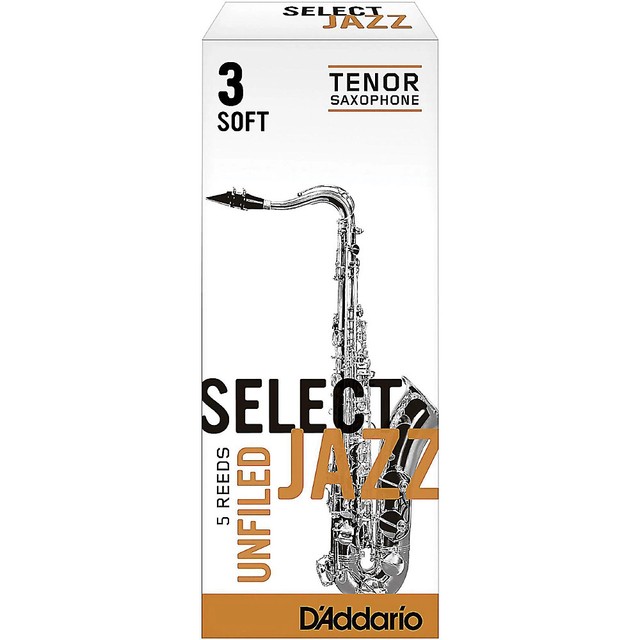
D’Addario Select Jazz Unfiled
The closest thing the category has to a default. A thick spine and a traditional tip shape give it projection and a focused, vibrant core, and the unfiled cut adds the extra resistance most tenor players want behind a jazz mouthpiece.
- Unfiled cut — no bark cut away above the shoulder
- Thick spine and blank
- Traditional tip shape
- Graded in 2S/2M/2H style half-strengths
- Boxes of 5
- The most consistent box-to-box of the mainstream cane jazz reeds
- The 2S/2M/2H grading means you can dial strength far more finely than whole numbers allow
- Focused enough to cut through a big band without turning shrill
- Well-known for dying quickly — players routinely report a short playing life
- Some long-time users feel consistency shifted after Rico rebranded to D’Addario

D’Addario Select Jazz Filed
Same blank, bark removed above the shoulder. That single change makes the reed speak sooner and sit brighter — the version to try if the unfiled feels like it is fighting you on your setup.
- Filed cut for faster response
- Same thick spine as the unfiled
- Identical 2S through 4H strength grading
- Boxes of 5
- Noticeably easier to blow at the same nominal strength than the unfiled
- Brighter, more immediate attack suits smaller-chamber mouthpieces
- Straightforward swap if the unfiled runs stuffy for you
- Less back-pressure to lean on, which some players read as thin
- Shares the unfiled’s reputation for a short life

Vandoren Java Red Cut
The buzzy one. Java Red has a thicker heart than the original Java and a distinctly vocal, slightly gritty edge that suits R&B, soul and anything where you want the horn to sound like it is working.
- Unfiled cut
- Thicker heart than the standard Java
- Red-tinted cane treatment
- Half strengths from 2 to 4
- Boxes of 5
- The most characterful jazz cut here — it has an obvious personality rather than being neutral
- Holds up better in the upper register than the green Java
- Very widely stocked, so easy to reorder anywhere
- More buzz than some players want; it will not give you a dark, polite sound
- Vandoren’s box-to-box variation is the usual complaint against the brand

Vandoren ZZ
Easy to play, bright and resonant — the reed to hand a player who wants jazz response without a fight. ZZ is the fastest-speaking cane cut on this list.
- Jazz cut with a thick heart and thin tip
- Very quick response
- Half strengths from 2 to 4
- Boxes of 5 or 10
- Speaks instantly, which makes it forgiving on a stiff or open mouthpiece
- Bright and resonant without the grit of the Java Red
- Popular enough that the strength you settle on is always in stock
- Shares Select Jazz’s reputation for dying quickly
- Can sound generic next to the Java Red if you want character

Vandoren Java (Green)
The original Java, and still a distinct reed from the Red — thinner through the heart, brighter, with more flex at the tip. A bebop-forward voice rather than a soul one.
- Unfiled jazz cut
- Thinner heart than the Java Red
- Very flexible tip
- Half strengths from 2 to 4
- Extremely flexible for bends, growls and altissimo work
- Feels lighter in the mouth than the Red at the same number
- Long-standing cut with decades of player data behind it
- The thin heart gives up body if you push hard
- Often mixed up with the Java Red in listings — check the box colour

Rigotti Gold Jazz
The consistency pick. Rigotti sorts every half strength into Light, Medium and Strong, so a box of ten arrives far more uniform than the competition — and players who switch to it usually cite that, not the tone.
- Light / Medium / Strong sub-grading inside each half strength
- Boxes of 10 rather than 5
- Bright, resonant jazz voice
- Premium French cane
- The most consistent box on this list by a wide margin — fewer duds per ten than any cane rival
- Boxes of 10 make the per-reed price competitive despite the premium positioning
- Lively, centred response with less buzz than the Javas and none of the stuffiness players report on Select Jazz
- The three-way sub-grading makes first-time ordering confusing
- Not carried by every general music shop — often easier to buy from sax specialists

Marca Superieure
The value play. Players routinely group Marca Superieure with Rigotti Gold, Java and ZZ as broadly similar reeds — and then point out that the Marca costs noticeably less.
- French cane, unfiled jazz-leaning cut
- Boxes of 10
- Half strengths available
- Long-established French maker
- Cheapest way into this tonal family without dropping to student cane
- Boxes of 10, so the per-reed cost is the lowest here among premium cuts
- A sensible bulk reed for practice so you save the expensive boxes for gigs
- Distribution is thinner than Vandoren or D’Addario, especially outside Europe
- Less name recognition, so resale and shop stock are both patchier

Rico Royal
Not a jazz cut, but it belongs on the list: a filed reed with a thin blank that responds easily, costs little, and is what a great many players are actually using while they figure out what they want.
- Filed cut on a thin blank
- Boxes of 3 or 10
- Quarter and half strengths widely stocked
- Rico’s long-running all-purpose line
- Cheapest reliable cane here — roughly $49 buys ten
- Easy blowing makes it the right reed while your embouchure is still settling
- Genuinely all-style: it will not stop you playing jazz on it
- Thin blank means less body and projection than any of the jazz cuts above
- Tone is neutral to the point of bland once your setup gets more demanding

Legere Signature
The synthetic that convinced sceptics. It plays out of the packet, never needs soaking, does not change as the gig gets hotter, and lasts months rather than weeks — which is why it turns up in pit orchestras and on outdoor stages.
- Polypropylene, not cane
- No wetting or break-in required
- Strengths in quarter steps
- Sold singly
- Completely stable across temperature and humidity — the whole argument for synthetics
- Months of life per reed makes the headline price misleading; per-hour it undercuts cane
- Ideal for doublers who cannot babysit four reeds between cues
- About $30 for one reed is a hard sell before you have tried it
- Slightly darker and more even than cane; some players miss the grain and unpredictability
- Strength conversion from cane is not one-to-one — expect to go a quarter step either way

Legere American Cut
Legere’s answer to the complaint that the Signature is too polite. The American Cut is brighter and more free-blowing, aimed squarely at players using jazz mouthpieces rather than classical ones.
- Synthetic, no soaking
- Brighter, freer cut than the Signature
- Quarter-step strengths
- Sold singly
- Closest a synthetic gets to the response of a good jazz cane reed
- Same months-long lifespan and weather stability as the Signature
- Pairs well with open-tip metal mouthpieces where the Signature can feel resistant
- The most expensive single reed here at around $38
- Brighter voice will not suit you if you play a darker, classical-leaning setup

Fibracell Premier
The budget synthetic — aramid fibres suspended in resin, engineered to mimic the fibre structure of cane. It is the cheapest way to find out whether synthetics suit you at all.
- Aramid fibre and resin construction
- No soaking or break-in
- Very light in weight
- Sold singly
- Roughly half the price of a Legere, so a much cheaper experiment
- Bright and highly responsive — it will not feel dead
- Same core advantages: weatherproof, no prep, long life
- Brighter and edgier than Legere; the tone divides opinion more sharply
- Feel is more obviously synthetic in the mouth than the Legere cuts
Buying tips
- Strength numbers do not transfer between brands. A Vandoren 3 is not a D’Addario 3 is not a Rigotti 3. Rigotti in particular sub-divides every half strength into Light, Medium and Strong, so a Rigotti 3 Medium sits somewhere near a Vandoren 3 but you should not bet a whole box on it. Buy one box, note where it lands, and adjust from there.
- Your mouthpiece decides the strength, not the horn. The more open the tip, the softer the reed you need. A player on a 7* hard rubber and a player on a 9 metal can want a full strength apart while playing the same tenor in the same section.
- Filed versus unfiled is the single biggest response difference. Filed reeds have the bark cut away above the shoulder and speak sooner and brighter; unfiled leave it on and give you more resistance to push against. D’Addario Select Jazz is the easiest place to test this because both versions exist on the same blank.
- Buy a sampler before a box. Both D’Addario and Vandoren sell mixed jazz packs of four reeds. Two sampler packs cost less than one wrong box of five and tell you far more.
- Budget for the duds. Cane is an agricultural product, and Select Jazz and ZZ in particular have a reputation for short life and inconsistency. Rigotti Gold’s sorting is the main reason players pay its premium — you are buying fewer wasted reeds, not a different sound.
- Rotate four reeds, not one. Playing the same reed every day is the fastest way to kill it. Break in four together, rotate daily, and each one lasts substantially longer.
- Synthetics earn their price on outdoor and pit work. A Legere costs about what six cane reeds cost but lasts months, ignores humidity, and needs no soaking between cues. If you play outdoors, double on multiple horns, or gig in a room whose temperature you cannot predict, that is the argument — not the tone.
- Do not judge a cane reed on day one. Most jazz cuts settle over three or four short sessions. A reed that felt too hard on Monday is frequently the best in the box by Thursday.
- Store them flat and dry. A reed case that holds the reed against a flat glass or plastic bed keeps it from warping and will do more for your reed budget than switching brands.
As an Amazon Associate and eBay Partner, toptenpick.com earns from qualifying purchases. Prices and availability are subject to change.