

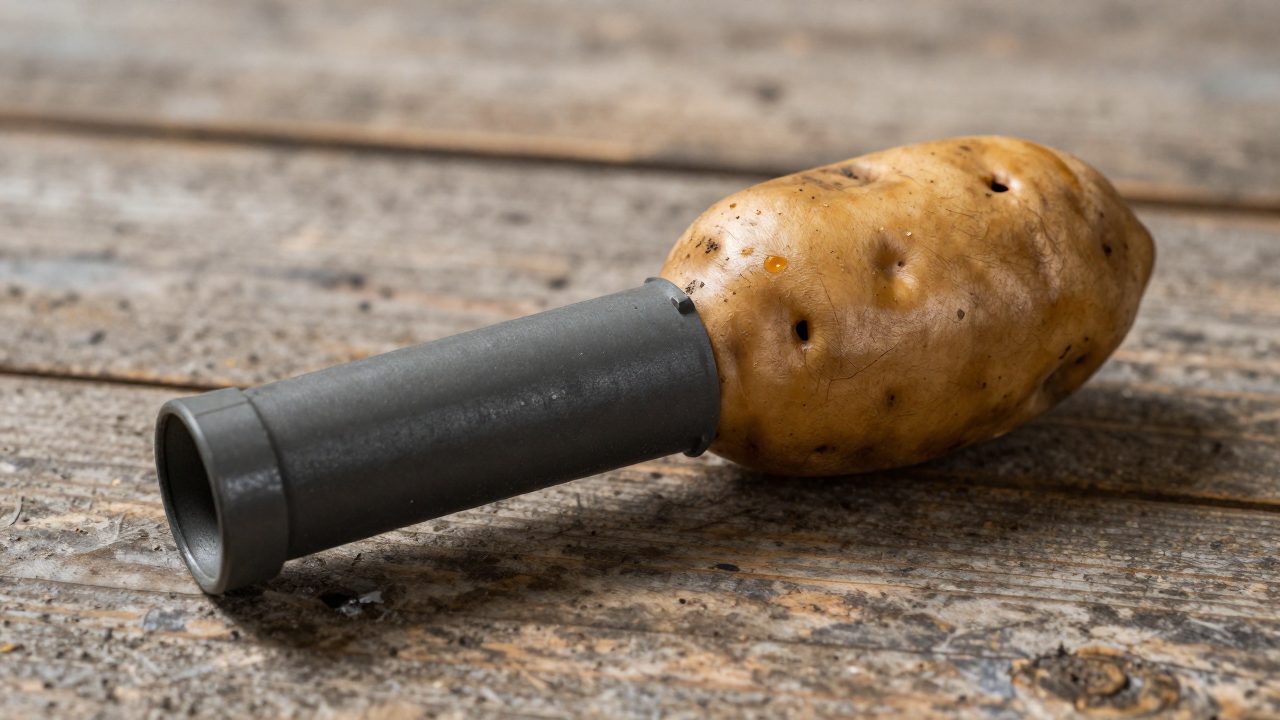
Devices sometimes called potato guns or potato launchers can involve pressurized gas, combustion, ignition sources and a projectile. Those elements can cause severe injury, fire, property damage or legal consequences. This is a safety and legal overview, not construction, repair, ignition, fueling or performance guidance. Do not build, modify, test or operate an improvised launcher.
Why an ignition system changes the risk
An ignition source is not a harmless switch. In any combustion-related device it can initiate a rapid energy release, and the hazard depends on fuel, containment, pressure, materials, damage and surroundings. A misfire does not mean the device is safe to inspect. Unburned fuel, residual pressure, a delayed ignition event and a blocked barrel can all create conditions that an untrained person cannot reliably assess.
The ATF explains that explosives regulation covers substances and devices intended to function by explosion, including igniters and several initiating materials. Federal, state and local definitions and enforcement can differ, and a device can create legal exposure even when a person describes it as recreational. A general web description or informal opinion is not legal advice and is not a safe basis for possession or use.
Do not treat common parts as safety certification
Household switches, wires, spark-producing components, pipes, containers and adhesives are not automatically suitable for a combustion or pressure application. Their presence in another product does not establish resistance to heat, pressure, fuel vapor, impact or repeated cycling. Materials can weaken without obvious external warning, especially after sunlight exposure, chemical contact, age, vibration or a previous abnormal event.
Improvised modifications add uncertainty. Changing a chamber, barrel, seal, trigger arrangement, fuel source or electrical connection changes the risks and may change how a law classifies the device. Do not seek an optimization step after a problem appears. Stop work, isolate the area, and obtain advice from a qualified local authority or an appropriately licensed professional where that is lawful and available.
Ignition principles without operating instructions
At a high level, ignition systems create a controlled electrical or mechanical event intended to start combustion. Safety engineering relies on a complete system: known materials, tested enclosure, appropriate controls, predictable operating conditions and trained oversight. An improvised setup lacks those assurances. A spark, battery or piezo element may look small while still presenting a shock, burn, fire or unexpected ignition hazard when combined with vapor or confined gas.
Do not test an igniter by introducing fuel, holding it near an opening, bypassing a switch, or probing damaged wiring. Do not use a damaged battery, frayed lead, exposed terminal or corroded connector. If there is any sign of heat, odor, damage, pressure, smoke or unexplained behavior, keep people away and contact emergency services if there is an immediate fire or explosive hazard.
Projectile and bystander hazards
A projectile launcher has risks beyond its power source. A projectile can strike a person, animal, window, vehicle or neighboring property, and an uncertain flight path makes distance an unreliable safety control. The danger includes ricochet, fragmentation, a blocked or obstructed path, and a device failure that sends material in an unexpected direction. Protective eyewear does not make an improvised launching device safe for use.
Never point, carry or display a launcher where it may be mistaken for a weapon or where others could feel threatened. Keep it away from roads, public places, homes, animals, dry vegetation and any location with an unknown backstop. Do not allow children to handle components, supervise a test, or retrieve a projectile. If a device is already assembled, prevent access rather than attempting an informal demonstration.
Legal and community considerations
Rules can cover discharge of projectiles, noise, fire codes, disorderly conduct, weapons definitions, explosive materials, parks, school grounds, transport and property damage. The answer may vary by city, county, state, country and the exact design or intended use. Contact the relevant local law-enforcement, fire-marshal or municipal office for current rules before any possession or activity, and obtain qualified legal advice for a specific situation.
Permission from a landowner is not a substitute for legal compliance, safe conditions or insurance. A rural location can still have burn restrictions, neighboring homes, animals, overhead utilities or public access. Public-safety agencies may appropriately treat an unfamiliar launcher as a serious threat until it is identified. Avoid transporting such a device openly or in a way that causes alarm.
A safer response to an existing device
If you find an unfamiliar launcher, ignition assembly, suspicious wire-and-container setup or damaged pressurized item, do not touch it, move it, take it apart or try to make it safe. Keep others away, avoid using radios or phones immediately beside a suspicious device, and contact local emergency services or law enforcement for direction. The ATF asks the public to report suspicious explosive devices rather than handle them.
For science, engineering or recreation, choose supervised activities with commercially designed equipment, recognized rules, trained instructors and a suitable venue. Those controls do not make every activity risk-free, but they provide a meaningful safety framework that improvised combustion launchers lack. The appropriate outcome for an unverified igniter concept is to stop, not to refine it.