

As an Amazon Associate and eBay Partner, toptenpick.com earns from qualifying purchases. Prices and availability are subject to change.
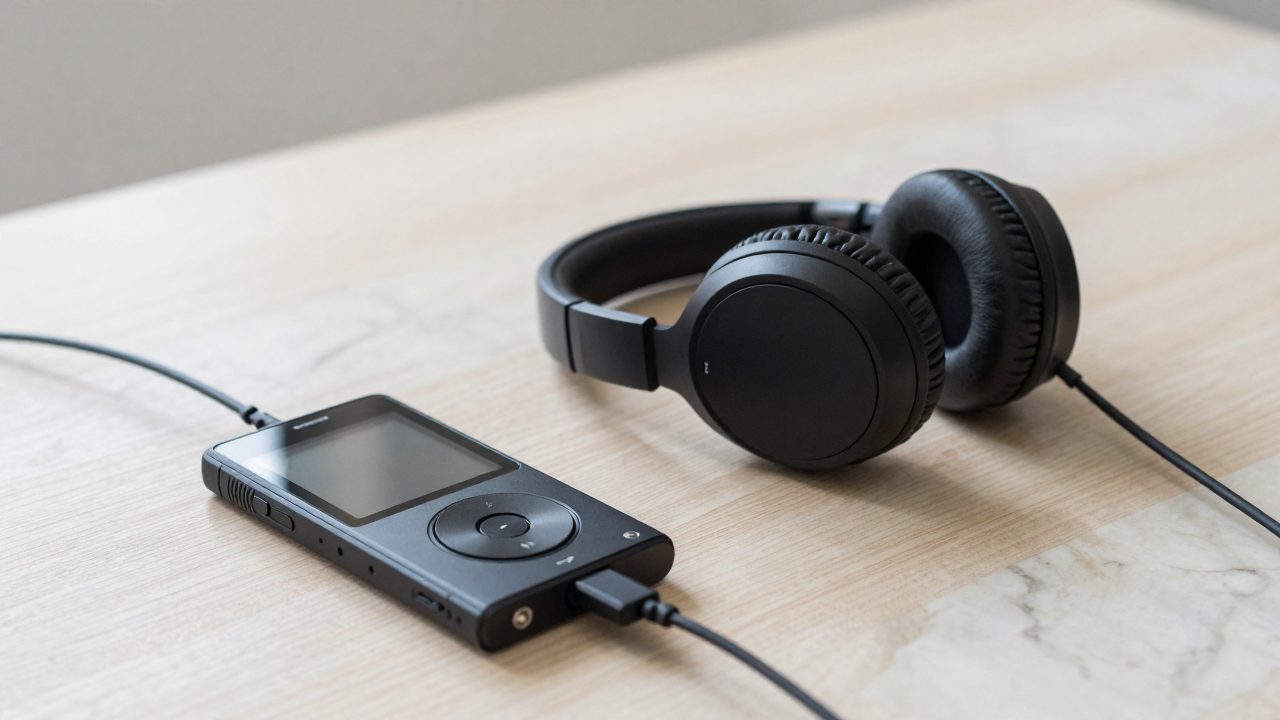
The FiiO X1 is a small battery-powered player with a modest headphone amplifier, and that single fact should decide your entire shortlist. It is not a desktop amplifier and it was never meant to be. Pair it with headphones that are easy to drive and it sounds clean, detailed and genuinely good for the money. Pair it with something hungry and the result is not distortion — it is worse than that. It is thin, quiet, bass-light sound that people mistake for the headphones being bad or the player being bad, when in fact the amplifier simply cannot deliver enough voltage or current to control the drivers.
So the spec to shop on is efficiency, expressed as two numbers. Impedance, in ohms, and sensitivity, usually in decibels per milliwatt. As a working rule for a portable player of this class: stay at or below roughly 50 ohms, and look for sensitivity around 100 dB/mW or higher. Headphones at 250 or 300 ohms — the classic studio models people recommend without checking — will play, quietly and without authority, and they will disappoint you.
The two numbers interact, which is where people get caught out. A high-impedance headphone with very high sensitivity can be fine; a low-impedance one with low sensitivity can be hard work. Planar magnetic headphones are the usual trap here — many sit at a friendly 32 ohms and have low sensitivity, so they need real current that a pocket player does not have. Low impedance is not the same as easy to drive.
If you already own something demanding, there is a fix. A small portable headphone amplifier fed from the X1’s line out — using the player as a source and letting the amp do the driving — is exactly what that output exists for. It is an extra box and an extra battery, and it is far cheaper than replacing headphones you like.
One last practical point in favour of the X1: it is a dedicated player with physical controls and a scroll wheel, and it takes a microSD card. Buy headphones with a replaceable cable if you can — on a device you carry, the cable is what fails first, and a headphone with a detachable cable outlives three that do not.
The list runs from the most efficient in-ears through to full-size headphones that genuinely work from a device like this.
| # | Product | Price | Where to buy |
|---|---|---|---|
| 1 | Sennheiser IE 200 | $100–$150 | Amazon · eBay |
| 2 | 7Hz Salnotes Zero or Similar Budget IEM | $20–$60 | Amazon · eBay |
| 3 | Koss Porta Pro | $35–$60 | Amazon · eBay |
| 4 | Sennheiser HD 25 | $130–$180 | Amazon · eBay |
| 5 | Grado SR80x | $100–$140 | Amazon · eBay |
| 6 | Audio-Technica ATH-M40x | $90–$130 | Amazon · eBay |
| 7 | MicroSD Card, 128 GB or Larger | $15–$35 | Amazon · eBay |
| 8 | Portable Headphone Amplifier | $60–$150 | Amazon · eBay |
| 9 | Replacement Cable with the Right Plug | $12–$35 | Amazon · eBay |
| 10 | 250/300-ohm Studio Headphones (avoid without an amp) | $100–$200 | Amazon |
The picks, in detail

Sennheiser IE 200
An easy-to-drive single dynamic driver in-ear that suits a portable player exactly. Low impedance and high sensitivity mean the X1 reaches comfortable volume with plenty of headroom left, and the tuning is the even-handed Sennheiser house sound rather than a bass-heavy consumer curve. Detachable MMCX cable, which on a carried device is the feature that decides how long it lasts.
- Single dynamic driver
- Low impedance, high sensitivity
- Detachable MMCX cable
- Tuning adjustable via eartip position
- Very easy for a portable player to drive
- Balanced, non-fatiguing tuning
- Replaceable cable
- Fit is fussy and needs tip rolling
- MMCX connectors wear out with repeated swapping
- Not the last word in bass slam

7Hz Salnotes Zero or Similar Budget IEM
The modern budget in-ear category is extraordinarily good value and almost all of it is easy to drive, which makes it a natural partner for this player. A single dynamic driver at around 32 ohms with high sensitivity plays loud and clean from a device like the X1 with volume to spare. Detachable cables are standard even at this price now, which was not true a few years ago.
- Single dynamic driver
- Around 32 ohms, high sensitivity
- Detachable 2-pin cable
- Neutral-leaning tuning
- Remarkable performance for the money
- Trivially easy to drive from a portable
- Replaceable cable at a very low price
- Build is plastic and basic
- Included tips are usually poor — budget for better ones
- Model churn in this category is rapid

Koss Porta Pro
A design from the 1980s that remains one of the best matches for a low-power portable source, because that is exactly what it was built for. Very high sensitivity and low impedance mean it goes loud from anything, the sound is warm and enjoyable rather than analytical, and it folds into a pocket. It leaks sound in both directions, which is the honest limitation.
- On-ear open-back design
- Low impedance with very high sensitivity
- Folds flat
- Lifetime warranty in some markets
- Designed for portable sources and drives from anything
- Genuinely fun, warm sound
- Very cheap and very light
- Open design leaks sound badly in both directions
- The headband comfort zones are divisive
- Cable is not detachable

Sennheiser HD 25
The DJ and broadcast standard, and the reason it belongs here is that it is designed to go very loud from portable equipment. Around 70 ohms but with high sensitivity, it is comfortably driven by a player like the X1, isolates well for travel, and is built to be repaired — every part is available as a spare, which is unusual and genuinely valuable on a headphone you carry.
- Closed on-ear, around 70 ohms
- High sensitivity for its impedance
- Every component available as a spare part
- Split headband, rotating earcup
- Loud and controlled from a portable source
- Fully repairable — pads, cable, headband, drivers
- Excellent isolation for its size
- Clamping force is high until broken in
- On-ear design gets warm over hours
- Bright, forward presentation is not for everyone

Grado SR80x
Open-backed, low impedance and high sensitivity, which makes it an unusually good full-size match for a modest portable amplifier. It plays loud easily and has the lively, forward Grado presentation that suits rock and acoustic material. Completely open, so it is a home headphone rather than a commuting one — everyone near you hears it and you hear everything.
- Open-back on-ear design
- Low impedance, high sensitivity
- User-replaceable pads
- Made in the United States
- Full-size sound from a low-power source
- Very engaging with guitar-based music
- Easily driven to loud levels
- Fully open — no isolation whatsoever
- Foam pads divide opinion on comfort
- Fixed cable that is thick and heavy for portable use

Audio-Technica ATH-M40x
The sensible closed-back full-size option for this player. At around 35 ohms with reasonable sensitivity it is comfortably within what a portable can drive, unlike its higher-impedance studio cousins, and the tuning is flatter and less bass-boosted than the more famous M50x. Detachable cable, which matters, and it folds for travel.
- Closed-back circumaural
- Around 35 ohms
- Detachable cable with a locking connector
- Folds flat for transport
- Genuinely drivable from a portable player
- Flatter tuning than the popular M50x
- Detachable cable and widely available spares
- Pads compress and need replacing within a couple of years
- Isolation is adequate rather than excellent
- Plastic build feels utilitarian

MicroSD Card, 128 GB or Larger
The X1 is a card-based player and the card is a real part of the purchase. A decent 128 or 256 GB card holds a substantial lossless library, and buying from a reputable brand matters more here than speed does — a player reads sequentially at modest rates, so a mid-tier card is plenty, while a counterfeit card that reports a capacity it does not have will silently lose the end of your library.
- microSDXC, 128 GB and larger
- Standard read speeds are ample for audio playback
- Format in the player where supported
- Buy from a reputable seller
- A large lossless library fits comfortably
- Cheap relative to the player
- Speed is not a constraint for audio
- Counterfeit cards are widespread in this market
- Very large cards can slow the player’s library scan
- Card can be lost when swapped

Portable Headphone Amplifier
The answer if you already own headphones the X1 cannot drive properly. Feed the amplifier from the player’s line output — which bypasses the internal volume and amplifier stage — and let a dedicated amp with its own battery do the work. It is cheaper than replacing headphones you like, and it turns the X1 into a source rather than asking it to be a source and an amplifier at once.
- Battery-powered portable amplifier
- Fed from the player’s line output
- Gain switch for different headphones
- Stacks with the player using bands or a case
- Lets you keep demanding headphones you already own
- Line out bypasses the player’s own amplifier stage
- Cheaper than new headphones
- Another device and another battery to charge
- The stack is bulky in a pocket
- Adds an interconnect cable that can introduce noise

Replacement Cable with the Right Plug
Worth a line because cables are what actually fail on a carried player, and because the plug matters. A right-angle plug puts far less strain on the player’s socket in a pocket than a straight one, and a headphone with a detachable cable can be revived for a few pounds when the cable inevitably develops a crackle. Check the connector type — MMCX and 2-pin are not interchangeable.
- MMCX, 2-pin or model-specific connectors
- Right-angle 3.5 mm plug options
- Various lengths including short portable runs
- Braided or silicone-sheathed
- Revives headphones with an intermittent cable
- Right-angle plug protects the player’s socket
- Short lengths suit pocket use
- Connector types are not interchangeable — check first
- Exotic cable materials make no audible difference
- Cheap cables are microphonic against clothing
250/300-ohm Studio Headphones (avoid without an amp)
Named because these are the headphones most often recommended to someone buying their first proper source, and they are the wrong match here. A 250 or 300 ohm studio headphone needs far more voltage swing than a pocket player provides; it will play, quietly, with thin bass and no dynamics, and the listener usually concludes the player is poor. They are excellent headphones fed by an amplifier that suits them.
- 250 or 300 ohm nominal impedance
- Designed for studio amplifier outputs
- Open or closed variants
- Replaceable pads and cables
- Genuinely excellent with an appropriate amplifier
- Comfortable for long sessions
- Well built and repairable
- Insufficient volume and no authority from a pocket player
- The result is usually blamed on the player
- Needs a desktop or portable amp to work properly
Buying tips
- Shop on impedance and sensitivity, not on reviews written with a desktop amplifier. For a player of this class, aim at or below roughly 50 ohms and around 100 dB/mW or better.
- Do not assume low impedance means easy to drive. Many planar magnetic headphones sit at a friendly 32 ohms and have low sensitivity, so they demand current a pocket player cannot supply.
- Recognise the symptom of a mismatch. Underpowering sounds thin, quiet and bass-light rather than distorted, which is why people blame the headphones or the player instead of the pairing.
- Use the line output if you add an amplifier. It bypasses the player’s own volume and amplifier stage, which is the entire point of having one.
- Buy headphones with a detachable cable. On anything you carry, the cable fails first, and a replaceable one turns a dead headphone into a fifteen-pound repair.
- Choose a right-angle plug for pocket use. A straight plug levers against the player’s socket every time you sit down, and that socket is not a cheap repair.
- Buy the microSD card from a reputable seller and do not chase speed. Audio playback is undemanding, but counterfeit cards that lie about capacity will quietly eat the end of your library.
- Try better eartips before concluding an in-ear is wrong. Fit changes bass response more than most equipment upgrades do, and stock tips are usually the cheapest part of the package.
As an Amazon Associate and eBay Partner, toptenpick.com earns from qualifying purchases. Prices and availability are subject to change.