

As an Amazon Associate and eBay Partner, toptenpick.com earns from qualifying purchases. Prices and availability are subject to change.
Tap-connected water changers are genuinely excellent devices and they introduce one specific way to kill your fish that bucket users never encounter. It is worth understanding before you buy one.
With a bucket, you treat the new water with dechlorinator in the bucket, and only treated water goes into the tank. With a tap-connected changer, untreated tap water goes straight into the aquarium. Chlorine and chloramine are added to drinking water specifically to kill microorganisms, and they will kill your filter’s beneficial bacteria and damage your fishes’ gills. The correct procedure is to dose the dechlorinator into the tank itself, for the entire tank volume, before you start refilling — not for the amount of water you are replacing. Dosing for the change volume is the mistake, and it is the standard one.
Once that is understood, the case for a tap-connected changer is strong. There is no lifting, no spillage, no bucket to store, and the physical effort of a water change stops being a reason to skip it — which matters, because the most common cause of poor water quality is simply not doing the change often enough.
The honest downside is water consumption. These devices work by running the tap to create suction through a venturi, so you use considerably more water than you remove from the tank — potentially several times as much. In a region with water restrictions or a meter, that is a real cost. A battery-powered pump changer removes it entirely and is the better choice if that matters to you.
One more thing worth saying because it is the most common beginner error: do not change all the water. Twenty to thirty per cent weekly is the normal routine. A complete change strips the tank of its established bacteria, swings the chemistry sharply, and causes exactly the crash people are trying to prevent. The cloudy tank that follows is the bacteria colony rebuilding from nothing.
Ten picks below.
| # | Product | Price | Where to buy |
|---|---|---|---|
| 1 | Tap-Connected Water Changer (Python-Style) | $40-$90 | Amazon |
| 2 | Battery or Electric Pump Water Changer | $30-$100 | Amazon · eBay |
| 3 | Manual Gravel Vacuum with a Priming Bulb | $10-$30 | Amazon · eBay |
| 4 | Water Conditioner (Dechlorinator) | $10-$30 | Amazon · eBay |
| 5 | Tap Adapter Set and Hose Fittings | $10-$30 | Amazon |
| 6 | Water Test Kit (Liquid Reagent) | $25-$50 | Amazon · eBay |
| 7 | Digital Thermometer for Matching Temperature | $10-$25 | Amazon · eBay |
| 8 | Algae Scraper or Magnet Cleaner | $12-$40 | Amazon · eBay |
| 9 | Dedicated Buckets and a Hose Storage Reel | $20-$50 | Amazon |
| 10 | Inline Tap Water Filter or RO Unit | $50-$300 | Amazon |
The picks, in detail
Tap-Connected Water Changer (Python-Style)
The device that makes water changes effortless, and for a tank over about twenty gallons it transforms the job. A long hose connects to a tap through a venturi adapter that creates suction to drain, then reverses to refill directly from the tap. No buckets, no lifting, no spillage on the carpet. The critical discipline is the dosing rule in the introduction — dechlorinator into the tank for the full volume before refilling. Get that right and there is very little to dislike.
- 25 to 50 ft hose
- Venturi tap adapter for suction
- Reverses to refill directly
- Gravel vacuum tube on the tank end
- No lifting or buckets at all
- Makes regular changes genuinely easy
- Drains and refills with one device
- Uses far more water than it removes
- Untreated tap water enters the tank — dosing discipline is essential

Battery or Electric Pump Water Changer
The alternative that avoids the venturi’s water consumption entirely. A small submersible pump moves water out of the tank and down a drain, then you refill from a container of treated water — so you use exactly what you replace. It also works where no tap adapter will fit, which covers a lot of modern mixer taps. It is more equipment and more steps than a tap-connected changer, and it is the right choice if you are on a meter or in a dry region.
- Submersible or inline pump
- Battery or mains powered
- Drains to a sink, drain or container
- No tap connection needed
- Uses only the water you actually replace
- Works with taps a venturi adapter will not fit
- Controllable flow rate
- More steps than a tap-connected changer
- Refilling still needs containers of treated water

Manual Gravel Vacuum with a Priming Bulb
The simple version and still the right answer for a small tank. A wide tube to disturb the gravel, a hose to a bucket, and a squeeze bulb to start the siphon without the traditional mouthful of aquarium water. For anything up to about twenty gallons it is quick, costs almost nothing and involves no plumbing. Buckets get heavy fast above that, which is the entire argument for everything else on this list. Get one with a flow control valve if you keep sand.
- Wide vacuum tube and flexible hose
- Priming bulb to start the siphon
- Flow control valve on better models
- Several tube diameters available
- Cheap, simple and nothing to break
- Dechlorinator goes in the bucket, which is easier to get right
- Perfectly adequate for a small tank
- Buckets are heavy above about twenty gallons
- Spills are a constant risk with carrying

Water Conditioner (Dechlorinator)
The product the introduction is really about. It neutralises chlorine and chloramine instantly, protecting both the filter bacteria and the fish. Two things to check: that it explicitly handles chloramine as well as chlorine, since many supplies use chloramine and many cheap conditioners only address chlorine; and the dosing instructions, because with a tap-connected changer you dose for the whole tank volume before refilling, not for the change volume. Buy a concentrated bottle — it is far cheaper per treatment.
- Neutralises chlorine and chloramine
- Instant action
- Concentrated formulations
- Some also detoxify ammonia and bind heavy metals
- The single most important product in this list
- Concentrates are very cheap per treatment
- Some versions also handle ammonia during a cycle
- Many cheap products do not handle chloramine
- Dosing for the change volume rather than the tank is the fatal error
Tap Adapter Set and Hose Fittings
The part that decides whether a tap-connected changer works in your house. Venturi adapters are made for traditional threaded taps, and modern mixer taps, pull-out spray heads and non-standard threads frequently will not accept one. An adapter set with several thread sizes and a rubber push-fit option covers most situations. Check your tap before buying the changer rather than after — this is the single most common reason a tap-connected system gets returned.
- Multiple thread sizes and adapters
- Rubber push-fit options for unthreaded taps
- Washers and seals included
- Standard hose connectors
- Resolves the most common fitment problem
- Cheap relative to returning the whole system
- Also useful for filling buckets quickly
- Some modern mixer taps simply cannot be adapted
- Push-fit adapters blow off under pressure
Water Test Kit (Liquid Reagent)
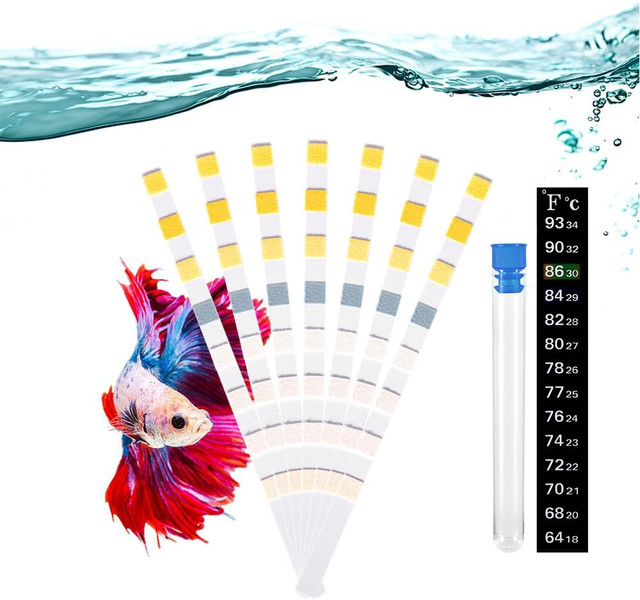
What tells you whether your change schedule is right. Nitrate accumulates between changes and is the number that indicates whether you are changing often enough or in large enough volumes — and ammonia and nitrite indicate whether something more urgent is wrong. Liquid reagent kits are considerably more accurate than paper strips and give hundreds of tests per kit. Test before and after a change for a few weeks and you will learn what your tank actually needs rather than following a generic schedule.
- Ammonia, nitrite, nitrate and pH
- Liquid reagents with colour comparison
- Hundreds of tests per kit
- More accurate than strips
- Tells you whether the change schedule is working
- Catches problems before fish show symptoms
- Far more accurate than test strips
- Reagents expire — check dates
- Several minutes per test

Digital Thermometer for Matching Temperature
Refill water should be close to tank temperature, and a tap-connected changer makes it easy to get this badly wrong — a rush of cold water into a tropical tank is a sharp thermal shock to fish that were fine a minute earlier. Mix the tap to roughly the right temperature before refilling and check it with a thermometer rather than by hand, which is a poor judge. A few degrees either way is tolerable; a sudden ten-degree swing is not.
- Digital probe thermometer
- Min/max recording
- Fast response for checking refill water
- Waterproof
- Prevents thermal shock during a refill
- Hands are a poor judge of water temperature
- Useful for monitoring the tank generally
- One more thing to have to hand mid-change
- Cheap probes drift over time

Algae Scraper or Magnet Cleaner
Do the glass before you drain, so the algae you scrape off comes out with the water rather than settling back down. A magnetic cleaner lets you do it without putting your arm in the tank, which is both more comfortable and better for the fish. Two cautions: check the scraper is safe for acrylic if your tank is acrylic, since steel blades scratch it permanently; and never let a magnet cleaner pick up a piece of gravel, which will grind a scratch across the glass in one pass.
- Magnetic inside and outside halves
- Blade or pad scrapers
- Acrylic-safe versions available
- Floating designs on better models
- Scraped algae leaves with the drained water
- No need to put an arm in the tank
- Floating versions do not sink if separated
- Steel blades permanently scratch acrylic
- A trapped grain of gravel scratches glass instantly
Dedicated Buckets and a Hose Storage Reel
Two practicalities. Buckets used for aquarium water must never have held detergent — residue that would not bother you at all is lethal to fish, and a rinsed bucket is not a clean one. Buy buckets that are only ever used for the tank and mark them. And a long changer hose left coiled on a floor kinks, tangles and eventually splits at the kinks; a simple wall reel keeps it straight and out of the way, and it costs very little.
- Food-grade buckets, aquarium use only
- Marked to prevent cross-use
- Wall-mounted hose reel
- Keeps long hoses kink-free
- Detergent residue is lethal to fish — dedicated buckets prevent it
- Reel stops the kinks that eventually split a hose
- Both cheap
- Buckets take up storage space
- Reel needs a wall to mount on
Inline Tap Water Filter or RO Unit
For water that is not simply chlorinated but genuinely unsuitable. If your supply is very hard, carries heavy metals, or has nitrates already in it — which is not unusual in agricultural areas — a conditioner cannot fix that, and you will be fighting your tap water permanently. An inline carbon filter helps with some of it; a reverse osmosis unit removes essentially everything, after which you remineralise to the hardness your fish actually want. It is a significant purchase and it solves problems nothing else will.
- Inline carbon or full reverse osmosis
- Removes hardness, metals and nitrate
- Remineralising salts used afterwards
- Storage container for produced water
- Solves source water problems no conditioner can
- Lets you set hardness to suit your species
- Essential for some sensitive fish
- RO units waste water and are slow
- RO water must be remineralised before use
Buying tips
- With a tap-connected changer, dose for the whole tank. Untreated tap water goes straight into the aquarium, so the dechlorinator must already be in the tank before you refill, dosed for the total volume — not for the amount you are replacing. Dosing for the change volume is the standard mistake and it is the one that kills filter bacteria and fish.
- Never change all the water. Twenty to thirty per cent weekly is the normal routine. A complete change strips the established bacteria, swings the chemistry sharply and causes exactly the crash people are trying to prevent. If a tank looks bad, more frequent partial changes are the answer, not one big one.
- Match the refill temperature. A rush of cold tap water into a tropical tank is a thermal shock to fish that were fine a minute earlier. Mix the tap to roughly tank temperature before refilling and check with a thermometer rather than by hand. A few degrees either way is fine; a sudden ten-degree swing is not.
- Understand the water cost before buying a venturi changer. These work by running the tap to create suction, so you use considerably more water than you remove — potentially several times as much. On a meter or under restrictions that is a real expense, and a pump-based changer avoids it entirely.
- Check your tap before buying a tap-connected system. Venturi adapters are made for traditional threaded taps, and modern mixer taps and pull-out spray heads frequently cannot accept one. This is the most common reason these systems get returned. An adapter set solves many cases; some taps simply cannot be adapted.
- Vacuum the gravel, do not just remove water. Most of the benefit of a water change is pulling out the waste trapped in the substrate, not the water itself. Work the tube properly into the gravel in sections, and do a different third of the tank each week rather than the whole floor every time — that keeps the bacteria in the substrate intact.
- Use buckets that have never held detergent. Residue that would not bother you at all is lethal to fish, and rinsing does not reliably remove it. Buy buckets used only for the aquarium, mark them clearly, and keep them somewhere they will not be borrowed for cleaning the car.
- Test nitrate to set your schedule. Nitrate accumulates between changes, and its level tells you whether your routine is sufficient for your stocking level — which no generic schedule can. Test before and after changes for a few weeks and you will know exactly what your tank needs rather than guessing.
As an Amazon Associate and eBay Partner, toptenpick.com earns from qualifying purchases. Prices and availability are subject to change.