

About this guide
David Foster Wallace wrote three novels, three story collections and a shelf of essays before his death in 2008, and the usual advice — start with Infinite Jest — is how most people bounce off him entirely. The essays are the better door in: same voice, same restless intelligence, a tenth of the commitment. Here are his books ranked by how much they reward the time, with a note on where each one actually sits in a reading order.
As an Amazon Associate and eBay Partner, toptenpick.com earns from qualifying purchases. Prices and availability are subject to change.
The picks, in detail

Infinite Jest
The 1,079-page novel that defined his reputation, and still the reason most people know the name.
- 1996
- Roughly 1,079 pages including 388 endnotes
- Set between a junior tennis academy and a halfway house
- Time magazine’s 100 best English-language novels 1923-2005
- Genuinely unlike anything else
- Very funny alongside the bleakness
- The endnotes demand two bookmarks
- First 200 pages are a real barrier

Consider the Lobster and Other Essays
The best single entry point: ten essays that turn ordinary assignments into something much larger.
- 2005
- Ten essays
- Title essay set at the Maine Lobster Festival
- Includes the John McCain campaign piece
- Perfect introduction to the voice
- Each essay stands alone
- Footnote habit is already in full force
- Range of subjects is deliberately scattered
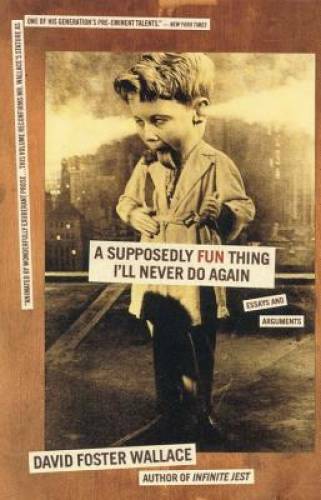
A Supposedly Fun Thing I’ll Never Do Again
The earlier essay collection, and the funniest thing he wrote — the title cruise-ship piece is a classic.
- 1997
- Seven essays
- Includes the Illinois State Fair and cruise-ship essays
- Also contains the David Lynch profile
- The most purely entertaining book he wrote
- Great in short sittings
- Two essays are dense literary criticism
- 1990s references date some of it

The Pale King
The unfinished final novel, assembled posthumously from his manuscripts — a book about boredom that is somehow not boring.
- 2011, posthumous
- Set in an IRS processing centre in Peoria
- Assembled by editor Michael Pietsch
- A 2012 Pulitzer Prize finalist
- Contains some of his very best writing
- More emotionally direct than Infinite Jest
- Genuinely unfinished, and it shows
- No resolution to speak of

Brief Interviews with Hideous Men
The story collection where the formal experiments and the moral seriousness lock together best.
- 1999
- Twenty-three stories
- Interview-transcript format throughout
- Includes ‘The Depressed Person’
- Short pieces, big impact
- ‘The Depressed Person’ is unforgettable
- Deliberately unpleasant in places
- Some experiments do not land
Oblivion: Stories
His last completed book of fiction, and the most technically accomplished of the story collections.
- 2004
- Eight stories
- Includes ‘Good Old Neon’ and ‘The Suffering Channel’
- ‘Good Old Neon’ is arguably his single best piece
- Mature, controlled prose
- The hardest of the collections to read
- Sentences run very long
This Is Water
The 2005 Kenyon commencement address, printed as a small standalone book you can read in twenty minutes.
- 2009
- Roughly 140 small pages
- One sentence per page in most editions
- The single most accessible thing he wrote
- Common gift book
- Very short for the price
- The full text circulates free online

The Broom of the System
The debut novel, written in his early twenties and openly indebted to Pynchon.
- 1987
- His first novel
- Adapted from his undergraduate thesis
- Much lighter and faster than the later work
- Fascinating as an origin point
- Clearly a young writer’s book
- Ending is abrupt

Girl with Curious Hair
The first story collection — uneven, but the high points show exactly where he was heading.
- 1989
- Ten stories
- Includes the novella ‘Westward the Course of Empire Takes Its Way’
- Some excellent early stories
- Short and varied
- The closing novella is heavy going
- Weakest of the three collections
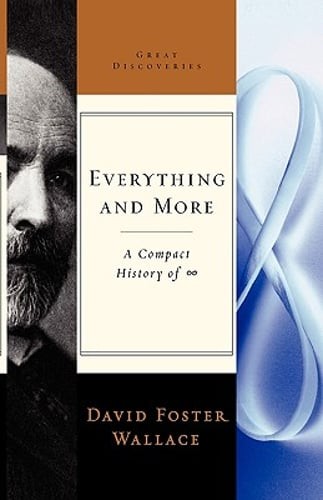
Everything and More: A Compact History of Infinity
A book-length popular history of infinity and Georg Cantor, and the outlier in his bibliography.
- 2003
- Popular mathematics
- Part of the Great Discoveries series
- Shows a completely different register
- Genuinely enthusiastic about the maths
- Mathematicians have flagged errors
- Hard going without some maths background
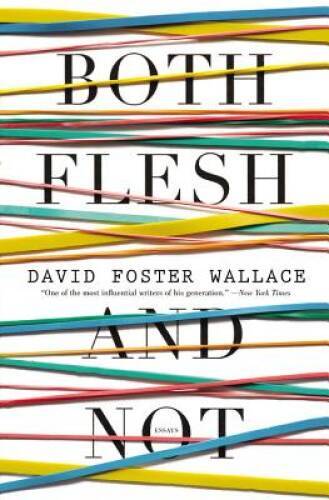
Both Flesh and Not: Essays
The posthumous gathering of uncollected essays, including the famous Roger Federer piece.
- 2012, posthumous
- Fifteen essays
- Includes ‘Federer Both Flesh and Not’
- The Federer essay alone justifies it
- Fills the gaps in the essay bibliography
- More scraps than a designed collection
- Includes vocabulary-list filler
What each one costs
Typical price, cheapest first. Tap a name to jump to that pick and its buy link.
Compare any three
| Infinite Jest | Consider the Lobster and Other Essays | A Supposedly Fun Thing I'll Never Do Again | |
|---|---|---|---|
| Price | $15-25 | $12-18 | $12-18 |
| Key features |
|
|
|
| Pros |
|
|
|
| Cons |
|
|
|
Buying tips
- Start with A Supposedly Fun Thing or Consider the Lobster. Almost everyone who begins with Infinite Jest and quits would have stayed if they had read the essays first.
- If you do take on Infinite Jest, use two bookmarks — one for the text and one for the endnotes, which are not optional and contain some of the best jokes.
- ‘Good Old Neon’ in Oblivion and ‘The Depressed Person’ in Brief Interviews are the two short pieces most worth reading if you only ever read two.
- Buy physical copies of the novels. The endnote structure in Infinite Jest and the footnotes throughout are genuinely painful to navigate on an e-reader.
- The Pale King reads better if you accept up front that it does not finish. Treat it as a collection of extraordinary sections rather than a novel with an ending.
- Used copies of the essay collections are plentiful and cheap — these were mass-market paperbacks, so there is no reason to pay full price.
As an Amazon Associate and eBay Partner, toptenpick.com earns from qualifying purchases. Prices and availability are subject to change.