

As an Amazon Associate and eBay Partner, toptenpick.com earns from qualifying purchases. Prices and availability are subject to change.
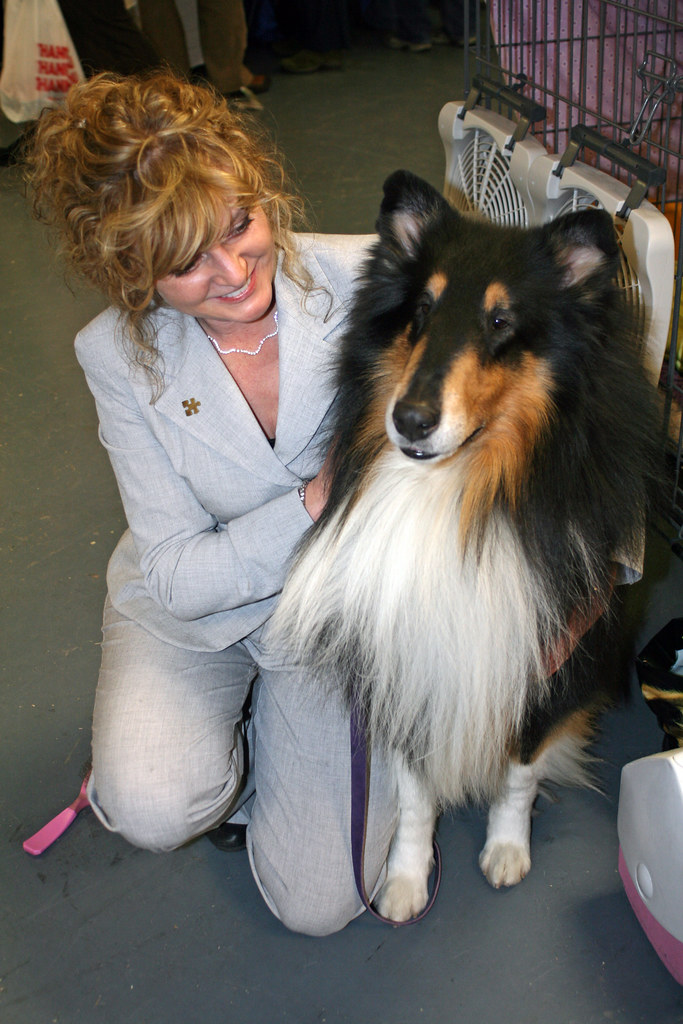
The mats on a rough collie are not in the part of the coat you can see. A collie carries two coats doing two different jobs: a harsh, straight outer coat of guard hair that sheds water and blocks sun, and beneath it a dense, woolly undercoat that holds heat. The long flashy hair on the outside almost never mats. The felted clumps form against the skin — behind the ears, low in the ruff, in the breeches behind the hind legs, and in the armpit behind each elbow. A pin brush drawn over the top of the coat sails straight over all of it and comes away with a satisfying cloud of hair while the mat underneath keeps tightening.
That single fact sorts the tools. Anything sold for long-haired dogs is designed to groom the outer coat, which is not where the problem is. What a collie needs is something that reaches the skin without cutting the guard hair on the way in and out.
Which is why the most popular de-shedding tools are the wrong answer here. Blade-style de-shedders — the FURminator and everything built like it — work by pulling loose hair against a fine cutting edge. On a short-coated dog that is harmless. On a rough collie the same edge shears the guard hairs it passes, and guard hair does not grow back the way it grew in the first place. Collie people will tell you they can still see where a blade tool was used a year later.
The technique matters as much as the tool, and it has a name: line brushing. You part the coat with one hand, brush the exposed strip from the skin outward, drop the part a half inch and repeat, working up the dog. It is slow — a full collie is an hour — but it is the only method that actually empties the undercoat rather than skimming it.
Two more things experienced collie owners do that first-time owners do not. They mist the coat lightly with water or a leave-in conditioner before starting, because dry guard hair is brittle and snaps under a brush. And they work through the coat with a steel comb at the end, not a brush — the comb is the honest test. A brush will glide through a coat that still has felt in it. A comb will not.
The list below is ordered for that job: reaching the skin, lifting the undercoat, and leaving the outer coat intact.
| # | Product | Price | Where to buy |
|---|---|---|---|
| 1 | Chris Christensen 27mm Oval Pin Brush | $50–$80 | Amazon · eBay |
| 2 | Chris Christensen T-Brush | $30–$50 | Amazon · eBay |
| 3 | Chris Christensen Big G Slicker Brush | $40–$65 | Amazon · eBay |
| 4 | Chris Christensen Buttercomb, fine and coarse greyhound style | $35–$55 | Amazon · eBay |
| 5 | Andis Steel Pet Comb, 7.5 inch coarse and fine | $8–$16 | Amazon · eBay |
| 6 | Safari Double Row Undercoat Rake | $12–$22 | Amazon · eBay |
| 7 | Hertzko Self-Cleaning Slicker Brush | $12–$22 | Amazon · eBay |
| 8 | JW Pet Gripsoft Slicker Brush | $8–$16 | Amazon · eBay |
| 9 | GoPets Dematting Comb, double sided | $15–$26 | Amazon · eBay |
| 10 | Mars Coat King Stripping Rake | $35–$70 | Amazon · eBay |
The picks, in detail

Chris Christensen 27mm Oval Pin Brush
The brush most collie show handlers reach for, and it earns the price on one detail: the pins are long enough to reach the skin through a full collie coat, and their tips are polished rather than cut flat. A rough-tipped pin scratches skin and splits hair; a ground tip does neither. The pad is a soft cushion, so the pins flex instead of gouging. This is the tool for the long daily maintenance pass.
- 27mm polished stainless pins
- Cushioned rubber pad with flex
- Beechwood body, oval head
- Built for thick double coats
- Pins genuinely reach the skin on a full coat
- Ground tips do not split guard hair
- Lasts decades with basic care
- Costs more than most people expect for a brush
- Does little on a coat that is already matted
- Counterfeits are common, so buy from a known seller

Chris Christensen T-Brush
Sold as an alternative to the undercoat rake, and it is the one tool here built specifically for the seasonal blow-out. The head is set crosswise to the handle so you pull along the dog’s body with your wrist neutral, which matters when the job takes an hour. It lifts dead undercoat in sheets from the ruff and breeches without a cutting edge anywhere on it.
- T-shaped head with cross-handle grip
- Long pins sized for double coats
- No blade or cutting edge
- Aimed at heavy seasonal shedding
- Clears undercoat fast during a blow-out
- Wrist-friendly for long sessions
- Cannot shear guard hair
- Too aggressive for weekly maintenance
- Premium price for a seasonal tool
- Will not break a set mat on its own

Chris Christensen Big G Slicker Brush
A slicker is the tool for the two or three places a collie actually mats, and this one has unusually long, fine, flexible wires on a large head. The flex is the point: a stiff slicker digs at the skin, and collies are notoriously thin-skinned. Use it behind the ears, in the armpits and through the breeches, in short strokes, then follow with a comb to check your work.
- Long flexible stainless wires
- Large head for body coverage
- Cushioned pad
- Wooden handle
- Reaches the skin-level felt a pin brush misses
- Flexible wires are gentler on thin skin
- Covers ground quickly on the body
- Easy to brush-burn skin if you lean on it
- Wires bend permanently if used on a hard mat
- Expensive for a slicker

Chris Christensen Buttercomb, fine and coarse greyhound style
The comb is the audit rather than the tool — it tells you whether the brushing actually worked. Half the teeth are spaced coarse for bulk, half fine for the finish pass. The teeth are rounded and polished, which is why it slides through coat that snags a cheap stamped comb. If this runs from skin to tip without catching, the dog is genuinely brushed out.
- Half coarse, half fine tooth spacing
- Rounded, polished teeth
- Solid brass body, nickel plated
- Around 7.5 inches long
- Honest test of whether a mat remains
- Teeth do not snag or scratch
- Heavy enough to work with, light enough to control
- Several times the price of a plain steel comb
- No handle, so it is awkward on a wriggling dog
- Not a de-shedding tool by itself

Andis Steel Pet Comb, 7.5 inch coarse and fine
The budget version of the same job, and for most owners it is enough. Stainless teeth, coarse on one half and fine on the other, with a rounded spine that is comfortable to hold. It will not glide quite like a polished show comb through a heavy ruff, but it will find every mat you missed, which is the entire reason to own a comb.
- 7.5 inch stainless steel comb
- Coarse and fine spacing in one tool
- Rounded tooth tips
- Chrome-plated finish
- Very cheap for what it does
- Finds mats reliably
- Easy to clean and will not rust
- Teeth drag more than a polished comb in dense coat
- No handle
- Plating wears through with heavy use
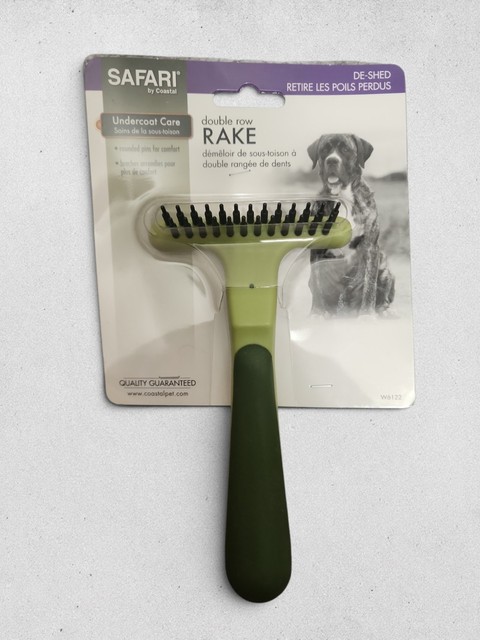
Safari Double Row Undercoat Rake
The double row of rounded pins is the classic shedding-season rake, and the shape is what makes it safe: each pin is a blunt post rather than a blade, so it drags dead undercoat out and slides past the guard hair. Work it in the direction of coat growth through the ruff and hindquarters and expect to fill a bag. It will do nothing useful on a mat.
- Two staggered rows of rounded pins
- Rotating pins on current models
- Moulded or wooden handle
- No cutting edge
- Cheap and stocked everywhere
- Pulls a lot of undercoat per stroke
- Blunt pins cannot shear guard hair
- Pins may not reach skin on a heavy adult coat
- Useless on existing mats
- Handle quality varies between production runs
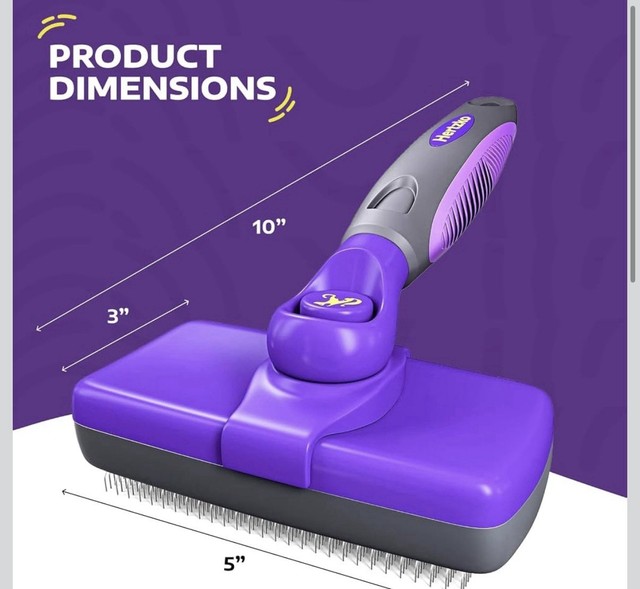
Hertzko Self-Cleaning Slicker Brush
The retractable-bristle slicker that sells by the truckload, and it has one real advantage on a collie: press the button and the wires withdraw, lifting a full pad of undercoat off in one piece. On a dog that produces this much hair, not having to pick a slicker clean every ninety seconds genuinely changes how long you last. The wires are stiffer than a show slicker, so use a light hand.
- Retractable wire pad, one-button clean
- Fine bent wires with protective tips
- Anti-slip moulded handle
- Standard and large head sizes
- Self-cleaning saves real time during a blow-out
- Very inexpensive
- Widely stocked and easy to replace
- Stiffer wires than a premium slicker, so brush burn is easy
- Wires bend and stay bent
- Standard head is small for a dog this size

JW Pet Gripsoft Slicker Brush
The sensible compromise for owners who want a slicker that will not injure the dog while they learn the feel of it. The wires are shorter and the pad smaller than the show slickers above, which limits how hard you can dig in, and the rubber-over-moulded handle is genuinely comfortable. Good for ears, feet and the fine work behind the elbows.
- Bent stainless wires on a cushioned pad
- Non-slip rubber grip handle
- Soft and firm versions available
- Small and large head sizes
- Hard to hurt the dog with it
- Comfortable handle for long sessions
- Costs less than a takeaway meal
- Short wires do not reach skin through a full adult coat
- Small head is slow over a body this size
- Not a serious de-matting tool

GoPets Dematting Comb, double sided
For the mats you find too late. One side carries twelve curved blades for breaking a felted clump apart, the other twenty-three for thinning what is left. It cuts — that is the honest description — so it is a rescue tool for a specific mat, not something to run over the whole dog. Used properly you cut into the mat from its outside edge, never across the guard coat.
- 12-blade coarse side, 23-blade fine side
- Curved stainless blades with one sharpened edge
- Silicone gel-filled handle
- Double-sided single tool
- Opens mats no brush will touch
- Comfortable grip for the force involved
- Cheap insurance to keep in the kit
- It is a cutting tool and will shorten coat wherever it passes
- Easy to nick skin in an armpit or behind an ear
- Leaves a visible gap in the outer coat if overused

Mars Coat King Stripping Rake
A professional undercoat stripper with rows of fixed blades set between guard rails, sold in different blade counts for different coat densities. It removes undercoat astonishingly fast. It also cuts, which is why it sits at the bottom of this list with a warning attached: on a coated breed a Coat King is a groomer’s tool used with a specific technique, and a heavy-bladed version in inexperienced hands will show on a collie.
- Fixed blades between protective rails
- Sold in 8, 10, 12, 16, 20 and 23 blade widths
- German-made hardened steel
- Wooden handle
- Removes undercoat faster than any rake
- Blade spacing can be matched to coat density
- Built to last a professional’s career
- It cuts the coat, and that is permanent if you get it wrong
- The wrong blade count makes things worse, not better
- Expensive and easy to misuse
Buying tips
- Skip anything with a blade sold as a de-shedding tool. A FURminator-style edge shears the guard hairs it passes, and on a rough collie that damage stays visible for a year or more.
- Learn line brushing before buying anything expensive. Part the coat with one hand, brush the exposed strip outward from the skin, drop the part half an inch and repeat — it is the only method that empties the undercoat rather than skimming it.
- Mist the coat before you start. Dry guard hair is brittle and snaps under a brush, and a light spray of water or leave-in conditioner is what prevents that.
- Check the four places that actually mat: behind the ears, low in the ruff, the breeches behind the hind legs, and the armpit behind each elbow. The rest of the dog is easy.
- Finish with a comb, never a brush. A brush glides over felt that a comb catches, so the comb is the only honest test of whether the dog is really brushed out.
- Buy on pin length, not on brand. On an adult collie a 27mm pin reaches skin and a short pet-store pin does not, whatever the packaging claims about long-haired dogs.
- Never shave a rough collie for summer. The outer coat is insulation against heat as well as cold and acts as a sunblock, and shaved collie coats often grow back patchy or woolly.
- Do the rake work outdoors during a blow-out and keep sessions short. Twenty focused minutes three times a week beats a two-hour battle that teaches the dog to hide from the brush.
As an Amazon Associate and eBay Partner, toptenpick.com earns from qualifying purchases. Prices and availability are subject to change.