

As an Amazon Associate and eBay Partner, toptenpick.com earns from qualifying purchases. Prices and availability are subject to change.
Tall cyclists usually shop for bib shorts by leg length, and leg length is not what is going wrong.
Think about the geometry. A bib short is a closed loop: the straps run over your shoulders, down your back and front, and connect to the shorts. If that loop is shorter than the distance it has to travel, something has to give — and what gives is the chamois pad, which gets pulled up and forward into your crotch. That is the source of the pressure, chafing and numbness that tall riders routinely blame on the pad itself, and it is why buying an expensive short with a better pad so often changes nothing.
The measurement that matters is torso length, not inseam. Two men of the same height can have very different splits between leg and torso, and it is the long-torso rider who suffers in standard bibs. The problem compounds when you get into the drops: your back flattens and lengthens, the loop needs even more length, and the straps pull the shorts down at the back and the pad up at the front simultaneously. Riders often report that bibs feel fine on the flat and unbearable on a long descent, and that is exactly why.
Which leads to the mistake almost everyone makes: sizing up to get strap length. It works, in the sense that the straps stop pulling. It also gives you leg grippers that no longer grip, a waist that bunches, and a chamois that is wider than the distance between your sit bones — so it folds, and a folded pad causes more trouble than a slightly small one.
The things to look for instead are a brand that offers a genuine tall or long cut rather than just more sizes, straps made from a stretchy mesh rather than a stiff webbing, and a Y-shaped or racerback strap layout that distributes over a longer path. Some brands publish torso length ranges alongside height; those are the ones to shop from.
Ten picks below, plus the items that solve the problems a good short still leaves.
| # | Product | Price | Where to buy |
|---|---|---|---|
| 1 | Bib Shorts in a Dedicated Tall or Long Cut | $120-$280 | Amazon · eBay |
| 2 | Bib Shorts with Stretch Mesh Straps | $90-$220 | Amazon |
| 3 | Bib Shorts with a Y-Back or Racerback Strap Layout | $100-$250 | Amazon · eBay |
| 4 | Bib Shorts with a Comfort Break Feature | $130-$280 | Amazon |
| 5 | Long-Leg or 3/4 Bib Knickers | $110-$250 | Amazon · eBay |
| 6 | Chamois Cream | $15-$35 | Amazon |
| 7 | Bib Short Strap Extenders | $8-$25 | Amazon |
| 8 | Saddle Sized for Your Sit Bone Width | $80-$300 | Amazon |
| 9 | Technical Wash for Lycra and Elastane | $10-$25 | Amazon |
| 10 | Cycling Base Layer | $30-$80 | Amazon · eBay |
The picks, in detail

Bib Shorts in a Dedicated Tall or Long Cut
The direct answer, and the thing to search for by name. A few manufacturers produce a genuinely lengthened version — longer straps, a longer body panel and often a slightly longer leg — rather than simply offering a larger size. That is a different pattern, not a scaled one, and it is what actually solves the problem described in the introduction. Availability is limited and they sell out, so buy when you find your size rather than waiting for a sale.
- Lengthened straps and body panel
- Cut for a longer torso, not just a bigger frame
- Leg length sized independently of the body
- Often published with torso length guidance
- Solves the actual problem rather than working around it
- Correct chamois position without sizing up
- Leg grippers still fit properly
- Limited range of brands and colours
- Popular sizes sell out and are not always restocked
Bib Shorts with Stretch Mesh Straps
The design feature that does most of the work when a dedicated tall cut is not available. Straps made from a genuinely stretchy power mesh accommodate a longer torso by extending, rather than transmitting the tension straight down into the chamois. Look for wide, soft mesh across the back rather than narrow elasticated webbing, and check how far the mesh actually stretches by hand in the shop. This is the single most useful feature to look for on a standard-cut short.
- Wide power mesh straps and back panel
- High stretch and recovery
- Breathable — mesh is cooler than solid fabric
- Flat seams where the strap meets the short
- Absorbs the extra length instead of pulling the pad
- Cooler and more breathable than solid straps
- Available across many brands
- Mesh loses stretch over a few seasons
- Some mesh backs are see-through when wet

Bib Shorts with a Y-Back or Racerback Strap Layout
A geometry that helps for a specific reason: converging the straps into a Y down the back gives them a longer path and lets the load spread across the shoulder blades rather than pulling straight up from the waistband. For a long-torso rider that extra effective length is genuinely useful. It also keeps the straps off the collarbones, where a wide parallel layout tends to sit uncomfortably under a jersey. Try before buying if you can — strap layouts suit different shoulder shapes.
- Y-shaped or racerback strap convergence
- Longer effective strap path
- Straps sit inboard of the collarbones
- Usually combined with a mesh back panel
- Extra effective length for a long torso
- Keeps straps off the collarbones
- Spreads load across the back
- Converged straps can rub between the shoulder blades
- Harder to get out of than a simple parallel layout
Bib Shorts with a Comfort Break Feature
A genuine quality-of-life feature and more relevant to tall riders than most, because a longer torso means more strap to get out of. Designs vary — a drop-tail rear panel, a front zip, or straps that detach — and all of them save the full undress that a standard bib requires. On long rides in cold weather this stops being a convenience and becomes the difference between stopping and not stopping. Check how the mechanism behaves when the short is under tension, which is the situation you will use it in.
- Drop-tail, front zip or detachable strap designs
- Full coverage restored when closed
- No compromise on the chamois position
- Available across price points
- Saves a full undress on long rides
- Particularly welcome in cold weather
- No performance penalty in most designs
- Zips and fasteners add potential pressure points
- Some designs are fiddly with cold hands
Long-Leg or 3/4 Bib Knickers
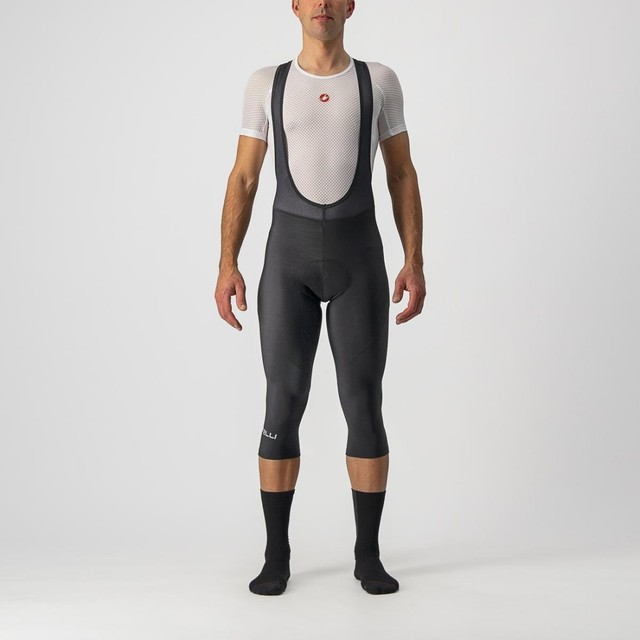
For genuinely long-legged riders, standard bib shorts often end above the knee in a place that looks and feels wrong, and the leg gripper sits on a wider part of the thigh than intended. Knickers extend below the knee and sidestep that entirely, and they are a sensible year-round option in a cool climate. As with shorts, check the strap length rather than assuming the longer leg means a longer body — plenty of knickers use the same upper pattern as the shorts.
- Leg ending below the knee
- Thermal or non-thermal fabrics
- Same chamois as the brand’s shorts
- Gripper below the knee rather than mid-thigh
- Correct leg length for tall riders
- Gripper sits where it is designed to
- Useful across a wider temperature range
- The upper pattern is often unchanged from the shorts
- Too warm for hot weather
Chamois Cream
Cheap, and it addresses friction directly rather than trying to eliminate it. A thin layer applied to the pad, to the skin, or both, reduces the rubbing that causes hot spots and saddle sores on long rides. Choose a formulation without menthol if you are not sure — the cooling versions are an acquired taste and unpleasant if you use too much. Apply before you ride, not after you feel the problem, and reapply on rides over a few hours.
- Anti-friction, often antibacterial
- Tubs, tubes and single-use sachets
- Menthol-free options available
- Chamois-safe formulations
- Directly reduces friction, which is the root cause
- Cheap and effective
- Sachets are easy to carry for reapplication
- Messy to apply and to wash out
- Menthol versions are strongly not for everyone
Bib Short Strap Extenders
A niche product that solves exactly this article’s problem on shorts you already own. A short length of elastic looped between the strap and the short adds the length a long torso needs, at trivial cost. It is inelegant and it works. Sold specifically for cycling in some places, and easily improvised from wide flat elastic and a couple of stitches if you cannot find one. Worth trying before replacing a wardrobe of shorts that are otherwise fine.
- Elastic loop adding strap length
- Attaches to existing straps
- Adjustable on some designs
- Very cheap or improvisable
- Fixes shorts you already own
- Costs almost nothing
- Immediately testable
- Adds a bulk point under a jersey
- Not a substitute for a properly cut short
Saddle Sized for Your Sit Bone Width
Belongs on this list because a great many problems blamed on shorts are actually the saddle. If the saddle is narrower than the distance between your sit bones, your weight lands on soft tissue instead of bone — and no chamois in the world fixes that. Most good bike shops will measure your sit bone width in a couple of minutes, often free. Getting the saddle right first means you can then judge whether the shorts are the problem, rather than changing both at once.
- Widths matched to sit bone measurement
- Cut-out or relief channel options
- Various padding levels and shell stiffness
- Many shops offer test saddles
- Fixes problems no short can address
- Sit bone measurement is quick and often free
- Test schemes let you try before committing
- A genuinely personal fit — expect trial and error
- Good saddles cost as much as good shorts
Technical Wash for Lycra and Elastane
The thing that keeps the straps stretchy. Ordinary detergent and, especially, fabric softener coat elastane fibres and destroy their recovery — which on a bib short means straps that stretch and stay stretched, undoing the one feature you bought them for. A technical wash cleans without that coating. Wash cold, inside out, no softener, no tumble dryer, and hang out of direct sunlight. Doubling the life of a $200 short is a good return on a $12 bottle.
- Formulated for elastane and technical fabrics
- No softeners or optical brighteners
- Removes body oils and salt
- Concentrated
- Preserves the strap stretch you paid for
- Removes the salt that degrades fabric
- Cheap relative to the kit it protects
- Costs more than ordinary detergent
- Needs the whole routine — cold, no softener, no dryer
Cycling Base Layer
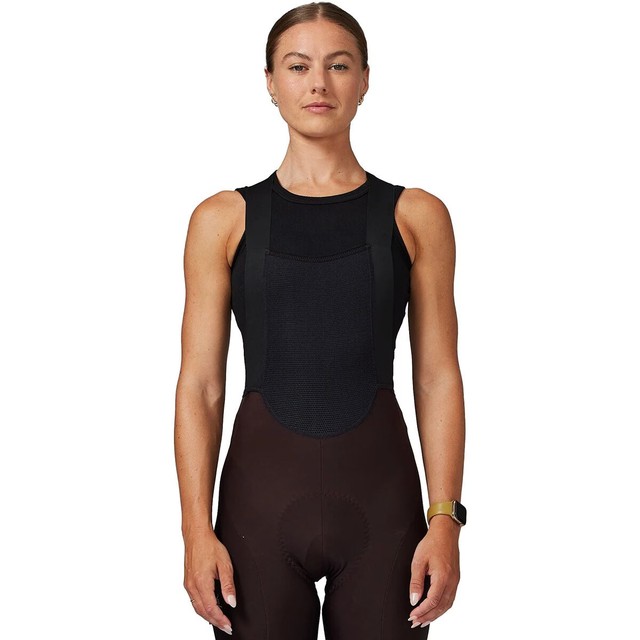
Worth including because of what it does about strap friction. A thin base layer under the bibs puts a smooth fabric layer between the straps and your skin, which for a long-torso rider under strap tension removes a real rub point at the shoulders and between the shoulder blades. It also wicks sweat off your back, which is where most of it goes on a road bike. Sleeveless mesh in summer, merino in cold weather. Wear it under the straps, not over them.
- Sleeveless mesh or merino long sleeve
- Worn under the bib straps
- Wicks sweat away from the back
- Flat or bonded seams
- Removes strap rub at the shoulders
- Genuinely cooler in summer, not warmer
- Keeps the jersey off a sweaty back
- Must go under the straps, which surprises people
- Another layer to wash after every ride
Buying tips
- Measure your torso, not your inseam. The problem is the closed loop from the shorts, over your shoulders and back down. If that loop is too short, the chamois gets pulled up into your crotch — which is the pressure and chafing usually blamed on the pad. Two men of the same height can need very different strap lengths.
- Do not size up to get strap length. It stops the pulling and introduces three new problems: leg grippers that no longer grip, a waist that bunches, and a chamois wider than your sit bones, which then folds. A folded pad causes more trouble than a slightly tight one. Find a longer cut instead, or add strap extenders.
- Test the fit in the drops, not standing up. Standing in a changing room your back is upright and the loop is at its shortest. On the bike in the drops your back flattens and lengthens and the straps pull hard. Get on a bike, or at least bend into a riding position, before deciding a pair fits.
- Look for stretch mesh straps rather than elasticated webbing. Wide power mesh absorbs the extra length by extending; narrow stiff webbing transmits the tension straight into the chamois. Stretch the straps by hand before buying — the difference between brands is large and it is the most useful feature available on a standard-cut short.
- Wear nothing underneath. Bib shorts are designed to sit against skin, and underwear adds seams, holds moisture and creates exactly the friction points the chamois exists to prevent. This surprises almost everyone new to cycling, and it is the single most common cause of first-ride discomfort.
- Rule out the saddle before blaming the shorts. If the saddle is narrower than your sit bones, your weight lands on soft tissue and no chamois fixes that. Most bike shops measure sit bone width in a couple of minutes, often free. Get the saddle right first, then judge the shorts — changing both at once tells you nothing.
- Wash with a technical detergent and never use fabric softener. Softener coats elastane and destroys its recovery, so the straps stretch and stay stretched — which undoes the feature you specifically bought. Cold wash, inside out, hang to dry out of direct sunlight, no tumble dryer. This routinely doubles the life of an expensive short.
- Use chamois cream from the start of a long ride. It reduces friction, which is the mechanism behind hot spots and saddle sores, and it works far better applied before there is a problem than after you feel one. Reapply on rides over a few hours — single-use sachets are easy to carry in a jersey pocket.
As an Amazon Associate and eBay Partner, toptenpick.com earns from qualifying purchases. Prices and availability are subject to change.