

As an Amazon Associate and eBay Partner, toptenpick.com earns from qualifying purchases. Prices and availability are subject to change.
Measure the tray before you read a single review, because on this truck the binding constraint is millimetres rather than milliamp-hours. The Super Baja Rey’s battery compartment sits in a range of roughly 150 × 43 × 70 mm up to about 180 × 48 × 85 mm depending on version and door, and a pack that is three millimetres too tall simply will not let the door close. Capacity charts will happily sell you a 6500 mAh brick that is physically impossible to install. Get a ruler into the tray, write the three numbers down, and treat them as a hard filter before anything else.
The second number is the cell count, and exceeding it is the expensive mistake in this hobby. The stock setup is 3S, running through a Dynamite Fuze 160 A waterproof ESC. More voltage is the obvious route to more speed and it is also the route to a released magic smoke: the ESC, the motor and the servo all have voltage ceilings, and going past them does not produce a warning, it produces a replacement bill. If you want 4S or above, the ESC and motor are part of that decision, not an afterthought.
Third, and specific to this truck: it is a basher, so the battery takes impacts. A 1/6 scale desert truck lands from real height, and a soft-pack LiPo in a tray is being compressed and flexed on every landing. Hard case is not optional here. A punctured or crushed cell is the failure mode this chemistry handles worst, and the case is what stands between a heavy landing and a fire. Secure retention matters for the same reason — a pack that shifts under landing loads chafes its own wires against the chassis.
Fourth, C rating buys headroom rather than speed. The Fuze ESC will draw what it draws; a higher C pack supplies it with less internal heating and less voltage sag, which shows as more consistent power late in a run rather than a higher top speed. On a big truck pulling serious current, that headroom is worth having.
And the running-cost point people discover later: the connector. This platform commonly uses EC5, and if your charger, your other packs and your truck do not all agree on one connector you will end up with a drawer of adapters, each one adding resistance and one more thing to get backwards.
Storage matters as much as any of it. Leave a LiPo fully charged between weekends and it loses capacity permanently; bring it to storage charge, around 3.8 V per cell, and it will last years.
| # | Product | Price | Where to buy |
|---|---|---|---|
| 1 | 3S 5000mAh 50C Hard Case LiPo, EC5 | $60–$110 | Amazon · eBay |
| 2 | 3S 5200mAh Hard Case LiPo | $65–$120 | Amazon · eBay |
| 3 | 3S 6000mAh+ Hard Case LiPo | $90–$160 | Amazon · eBay |
| 4 | Dynamite or Spektrum 3S Smart LiPo | $90–$150 | Amazon · eBay |
| 5 | LiPo Balance Charger with Storage Mode | $60–$150 | Amazon |
| 6 | LiPo Safe Bag or Metal Charging Case | $15–$40 | Amazon · eBay |
| 7 | EC5 Connector Pairs | $12–$30 | Amazon |
| 8 | Battery Tray Foam and Retention Straps | $8–$20 | Amazon · eBay |
| 9 | Cell Voltage Checker | $8–$20 | Amazon · eBay |
| 10 | 4S or 6S Pack Without an ESC Upgrade (do not) | $100–$200 | Amazon · eBay |
The picks, in detail

3S 5000mAh 50C Hard Case LiPo, EC5
The sensible default and the pack most Baja Rey owners settle on. Three cells keeps you inside the stock ESC and motor ratings, 5000 mAh is a realistic run time for a truck this size, and 50C gives the current headroom a 160 A ESC can ask for. Hard case is essential on a basher. Check the case dimensions against your own tray — 5000 mAh packs vary in shape between brands.
- 3S 11.1 V, around 5000 mAh
- 50C continuous discharge rating
- Hard case construction
- EC5 connector on most
- Within the stock ESC and motor ratings
- Good balance of run time and weight
- Hard case suited to a bashing truck
- Case dimensions vary between brands — measure first
- Heavier than a soft pack of the same capacity
- 50C ratings are optimistic across the industry

3S 5200mAh Hard Case LiPo
A small step up in capacity in a case size that commonly still fits, which is the useful combination. The extra 200 mAh is marginal on its own; what matters is that several packs in this class are built to the shorter end of the dimensional range and therefore clear doors that a 6500 mAh brick will not. Worth seeking out if your tray measured at the tighter end.
- 3S 11.1 V, around 5200 mAh
- Hard case in a commonly compatible size
- 50C class discharge
- EC5 or bullet connectors
- Fits trays that larger packs will not
- Slightly longer runs than a 5000 mAh
- Widely stocked
- Capacity gain over 5000 mAh is negligible in practice
- Still needs measuring against your specific door
- Connector varies by seller

3S 6000mAh+ Hard Case LiPo
The long-run option, for people who would rather drive than swap packs. The trade is physical: higher capacity means a bigger case, and this is exactly where the tray measurement stops being advice and starts being a wall. It is also heavier, which on a truck that jumps changes how it lands. Measure twice, and expect the door to be the deciding factor.
- 3S 11.1 V, 6000 mAh and above
- Larger hard case
- High C ratings available
- Noticeably heavier
- Substantially longer run time
- Fewer pack swaps in a session
- Less sag under sustained load
- Frequently too large for the tray and door
- Added weight changes jumping and landing behaviour
- Costs more and takes longer to charge

Dynamite or Spektrum 3S Smart LiPo
The in-house option for this platform, and the argument for it is the Smart system: the pack carries its own data, so a compatible charger reads cell count, capacity and health automatically and sets itself. That eliminates the commonest way people damage a LiPo — charging it at the wrong cell count. Sized to fit the trucks it is sold alongside, which removes the measuring problem too.
- Smart telemetry data stored in the pack
- Auto-configuring on compatible chargers
- Hard case sized for Horizon platforms
- IC5 / EC5 compatible connector
- Charger sets itself — removes a whole class of mistake
- Fitment designed around these trucks
- Telemetry tracks pack health over time
- Smart features need a compatible charger
- Premium pricing
- Telemetry is wasted if you never look at it
LiPo Balance Charger with Storage Mode
The thing that determines whether your packs last one season or five. Balance charging keeps the cells within a pack level, and the storage function — bringing a pack to about 3.8 V per cell — is what stops a battery left charged between weekends from quietly losing capacity. A charger that can do both, at a current high enough to fill a 5000 mAh pack in reasonable time, is the right purchase.
- Per-cell balance charging
- Storage mode to around 3.8 V per cell
- Multiple chemistries
- Higher amp models charge large packs faster
- Storage mode alone extends pack life by years
- Balancing prevents internal cell drift
- One charger covers every pack you own
- Good units need a separate power supply
- Cheap chargers overstate their output current
- Smart packs need a compatible charger for auto-setup
LiPo Safe Bag or Metal Charging Case
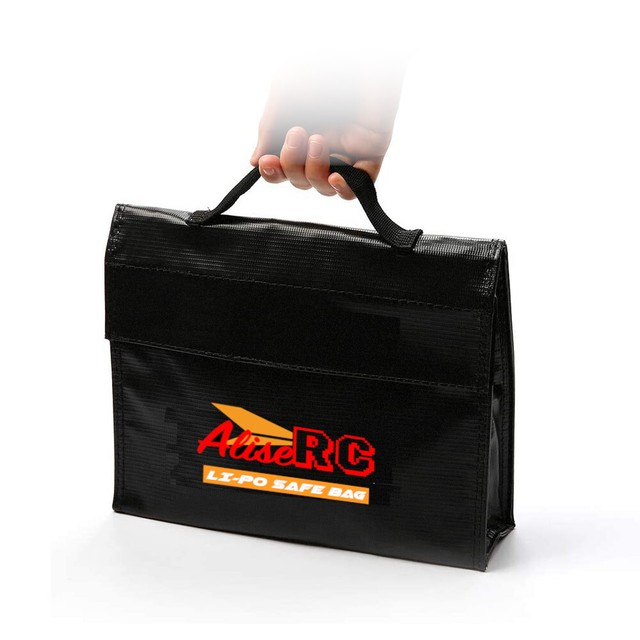
Non-negotiable with this chemistry, and doubly so on a truck that crashes. A pack that has taken a heavy landing can fail later rather than immediately, so charging and storing in a fire-resistant container is protecting against a delayed failure as much as an immediate one. Charge on a hard non-flammable surface, in the bag, never unattended.
- Fire-resistant fibreglass or steel construction
- Sized for large hard-case packs
- Bag and ammo-can style options
- Vented designs on better models
- Contains the failure mode LiPo actually has
- Matters more on a truck whose packs take impacts
- Very cheap
- Fire-resistant, not fireproof
- No substitute for watching the charge
- Larger packs need a larger bag than most come with
EC5 Connector Pairs
Standardising your connectors is worth an hour with a soldering iron. Adapters add resistance, add heat, add another joint to fail and add a chance of getting polarity backwards in the dark at a track. If the truck is EC5, convert your chargers and other packs to match. Use proper gauge wire and a decent iron — a cold joint on a 160 A path is a fire waiting for a throttle punch.
- High-current bullet-in-housing connectors
- Polarised housings prevent reversal
- Sold as matched male and female pairs
- Heat shrink usually included
- Removes adapter chains and their resistance
- Polarised, so no reversed connections
- Rated well above what this truck draws
- Requires competent soldering on heavy wire
- Converting a fleet of packs takes an evening
- A cold joint at these currents is genuinely dangerous

Battery Tray Foam and Retention Straps
Cheap, and it addresses a failure specific to a jumping truck. A pack that moves in the tray on landing chafes its own leads against the chassis, and a chafed lead in a 160 A circuit is exactly the short you do not want. Dense foam packs out the gap so the battery cannot move, and a fresh strap keeps it there. Replace straps when they stop gripping — they are consumables.
- Dense closed-cell foam packing
- Reinforced hook and loop straps
- Cut to fit the tray
- Cheap and replaceable
- Stops the pack moving under landing loads
- Prevents lead chafing, which causes shorts
- Costs a few pounds
- Foam compresses and needs replacing
- Too much packing makes the door hard to close
- Straps lose grip when sandy
Cell Voltage Checker
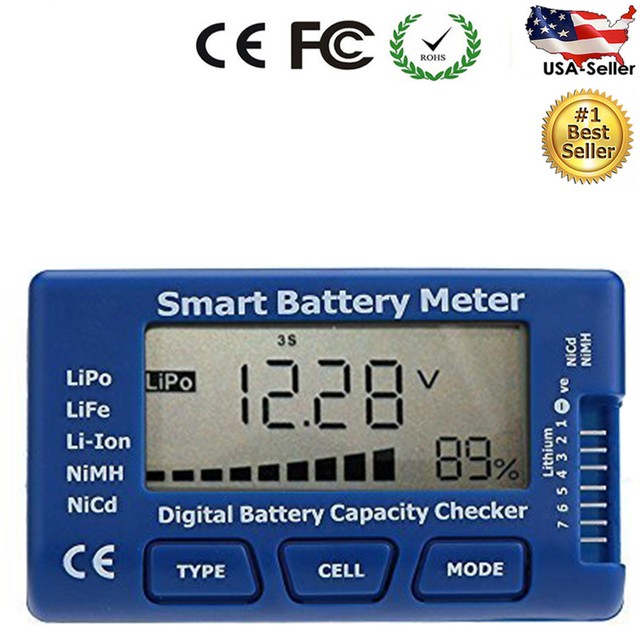
A pocket device that plugs into the balance lead and reads each cell. On a basher its most useful job is catching a damaged pack early: after a heavy landing or a rollover, a cell that reads noticeably lower than its neighbours has been stressed, and that pack should come out of rotation before it is charged again. Two pounds, and it tells you something a charger’s summary does not.
- Plugs into the balance connector
- Per-cell and pack voltage display
- Alarm versions available
- Pocket sized
- Catches a damaged cell after an impact
- Instant check without setting up a charger
- Very cheap
- Cheap units drift in accuracy
- Easy to lose in a pit bag
- Tells you nothing about internal resistance
4S or 6S Pack Without an ESC Upgrade (do not)
Named because it is the tempting shortcut and the costly one. More cells means more voltage, and the stock ESC, motor and servo all have ceilings that a 4S or 6S pack walks straight past. Nothing warns you — it works, then it does not, and the bill covers an ESC and often a motor. Raising the cell count is a whole-drivetrain decision and the battery is the last part of it, not the first.
- 4S 14.8 V or 6S 22.2 V
- Substantially more voltage than stock
- Same physical formats as 3S packs
- Requires matched ESC and motor
- Genuinely much faster in a correctly specified setup
- Exceeds the stock ESC, motor and servo ratings
- Failure is sudden and expensive rather than gradual
- Only sensible as part of a planned drivetrain upgrade
Buying tips
- Measure the tray in three dimensions before reading any review. The compartment runs roughly 150 × 43 × 70 mm to about 180 × 48 × 85 mm depending on version, and a pack three millimetres too tall will not let the door close.
- Stay at 3S unless you are upgrading the ESC and motor together. The stock Fuze ESC, motor and servo all have voltage ceilings, and exceeding them fails suddenly and expensively rather than gradually.
- Buy hard case, always. This truck lands from real height and a soft pack in a tray is compressed on every landing — a crushed cell is the failure this chemistry handles worst.
- Treat C rating as headroom, not speed. A higher C pack supplies the same current with less heating and less sag, which shows as consistent power late in a run.
- Pack the tray with foam and use a fresh strap. A battery that shifts on landing chafes its own leads against the chassis, and a chafed lead in a 160 A circuit is a short.
- Standardise on one connector and stop using adapters. Every adapter adds resistance and a joint, and a drawer of mixed connectors is how people reverse polarity.
- Check per-cell voltage after any heavy crash. A cell reading lower than its neighbours has been stressed, and that pack should leave the rotation before it is charged again.
- Store at about 3.8 V per cell between sessions. A pack left fully charged for weeks loses capacity permanently, and storage mode is one button on any decent charger.
As an Amazon Associate and eBay Partner, toptenpick.com earns from qualifying purchases. Prices and availability are subject to change.