

As an Amazon Associate and eBay Partner, toptenpick.com earns from qualifying purchases. Prices and availability are subject to change.
Walk into the 73-key section of any keyboard shop, real or online, and notice how thin it is — a handful of models wedged between a crowded wall of 61-key controllers and a smaller but still healthy lineup of 88s. That’s not an accident of merchandising: 73 and 76-key boards are a genuinely underserved size. The real decision most buyers face isn’t ‘which 73-key controller is best’ so much as ‘do I even want this size’ — a 61 you’ll outgrow, or an 88 that won’t fit the back seat of a car or the corner of a small studio.
Key count is also the wrong first question. Key action — synth-action (light and springy, built for pads and leads), semi-weighted (some spring-back, good for organ and synth work), and hammer-action (simulates a real piano hammer) — decides how a board feels far more than whether it has 73 or 76 keys. Weight follows action, not size: even a dedicated hammer-action controller with no sounds at all, the Studiologic SL73 MK2, weighs 24.7 lb (11.2 kg) despite Studiologic’s own ‘feather-light’ marketing — heavier than several full 76-key synth workstations below. Gigging light favors semi-weighted or synth-action; wanting real piano feel for practice or recording means budgeting for the extra weight, because there’s no shortcut at this key count.
The decision buyers gloss over entirely is whether they want a MIDI controller — no built-in sounds, purely there to trigger software or another synth over USB — or a stage piano/workstation that also happens to work as one. Dedicated 73-key controllers are rare; the SL73 MK2 is close to the only one currently made at this size. Most of what fills out a ‘best 73-key’ list, this one included, is actually a full instrument — an organ/piano/synth workstation, a stage piano, or an arranger keyboard — that can control other gear over MIDI but arrives with its own sound engine, display, and price tag.
That price spread matters: a bare controller runs a few hundred dollars, while a flagship three-engine stage piano or arranger workstation runs into the thousands, because you’re paying for onboard organs, pianos, and synth engines, not just a keybed and a USB port. Match the price to what you’ll use — a $4,000 workstation to run one software synth from a laptop is a lot of instrument you’ll never touch.
| # | Product | Price | Where to buy |
|---|---|---|---|
| 1 | Studiologic SL73 MK2 | $459–$600 | Amazon · eBay |
| 2 | Nord Stage 4 HA73 | $5,700–$5,900 | Amazon · eBay |
| 3 | Nord Stage 4 Compact 73 | $3,600–$4,200 | Amazon · eBay |
| 4 | Korg Nautilus 73 | $2,000–$2,700 | Amazon · eBay |
| 5 | Yamaha MODX M7 | $2,299–$2,499 | Amazon · eBay |
| 6 | Kurzweil PC4-7 | $2,899–$3,099 | Amazon |
| 7 | Roland Juno-DS76 | $799–$949 | Amazon · eBay |
| 8 | Vox Continental 73 BK | $1,185–$1,499 | Amazon |
| 9 | Roland Fantom-07 | $2,199–$2,399 | Amazon · eBay |
| 10 | Yamaha Genos2 | $3,700–$5,000 | Amazon · eBay |
The picks, in detail

Studiologic SL73 MK2
A dedicated 73-key MIDI controller with no built-in sounds, built around Fatar’s TP/110 hammer-action keybed with individual-key aftertouch, in a market where true 73-key controllers are otherwise nearly extinct. The MK2 update adds a USB-C audio interface, MIDI 2.0, and the UX Logic control system carried over from Studiologic’s Numa X Piano.
- Fatar TP/110 hammer-action keybed with aftertouch
- USB-C connection that doubles as an audio interface
- MIDI 2.0 in/out plus 5-pin MIDI
- DAW transport controls and Numa Player integration
- Close to the only currently-made dedicated 73-key controller
- Hammer action with real aftertouch, not just velocity
- Built-in audio interface removes a separate box from the setup
- 24.7 lb is still heavy to carry to every gig
- No built-in sounds — needs a laptop or sound module to make noise
- Pricier than most 61-key controllers with similar features

Nord Stage 4 HA73
Nord’s flagship stage keyboard in its 73-key hammer-action configuration, combining a full organ engine with physical drawbars, the Nord Piano Library, and a Nord Wave 2 synth engine across seven simultaneous layers. It’s built for players who want piano, organ and synth on one real stage rig, and it transmits over both USB and 5-pin MIDI when you need it to drive other gear too.
- 73-key Triple Sensor hammer-action keybed with aftertouch
- Physical LED organ drawbars
- 2GB Nord Piano Library plus Nord Wave 2 synth engine
- Simultaneous organ, piano and synth layers with independent effects
- Three professional instruments in one keybed
- Fast, knob-per-function workflow with no menu diving
- Well-supported brand on professional stages worldwide
- Expensive relative to a plain controller — you’re paying for the sound engines
- No on-board sequencer or DAW-style recording
- Sample content isn’t user-expandable the way a computer sample player is
Nord Stage 4 Compact 73
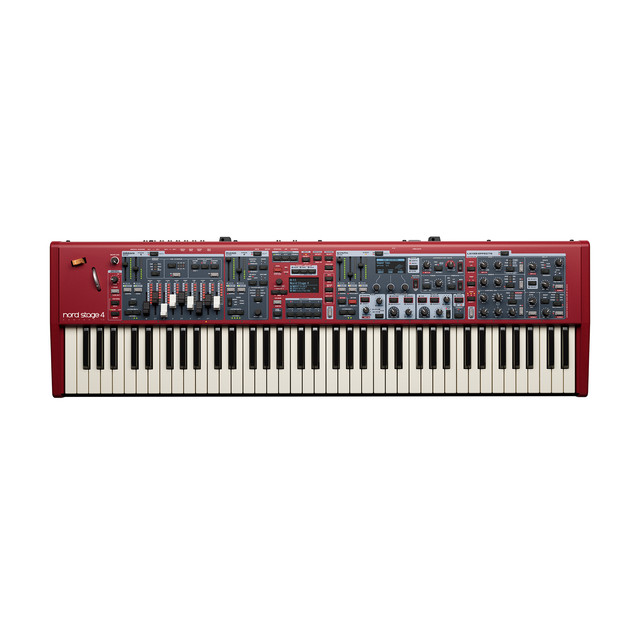
The same three-engine Stage 4 architecture in a lighter 22.9 lb body with a semi-weighted waterfall keybed instead of hammer action — the flat-fronted waterfall design is built for the organ smears and glissandos a hammer action resists. It suits gigging keyboardists and worship or session players who want Nord’s organ and piano sounds without carrying a hammer-action board to every load-in.
- 73-key semi-weighted Triple Sensor waterfall keybed with aftertouch
- 22.9 lb compact chassis
- Same organ, piano and synth engine trio as the full Stage 4
- Physical drawbars and a dedicated synth control section
- Noticeably lighter and more compact than the hammer-action Stage 4
- Waterfall keys are genuinely better suited to organ technique
- Same sound engines as the flagship, not a stripped-down version
- Semi-weighted action feels less like an acoustic piano than the HA73
- Still a premium price for what is mechanically a controller plus organ
- Compact chassis has fewer physical controls than the full-size Stage 4

Korg Nautilus 73
Korg’s flagship workstation in a 73-key configuration with a light-touch, Natural Touch semi-weighted keybed — a size Korg added because customers specifically asked for something between the Nautilus 61 and 88. Nine sound engines cover pianos, tonewheel organs and analog synth modeling, with a 7-inch touchscreen for deep editing when you need it.
- 73-key Natural Touch semi-weighted keybed
- Nine onboard synthesis engines, 2,200 programs and combinations
- 240-note polyphony with a 7-inch TouchView touchscreen
- 16-track MIDI plus 16-track audio sequencer with sampling
- Exceptional sound-engine variety in one keyboard
- Semi-weighted action is comfortable for both synth and piano parts
- Full sequencer and sampler let it work as a standalone production tool
- Deep menus take real time to learn compared to a simple controller
- Heavy and large for a 73-key board once you factor in the workstation electronics
- A big investment if all you actually need is a MIDI controller
Yamaha MODX M7
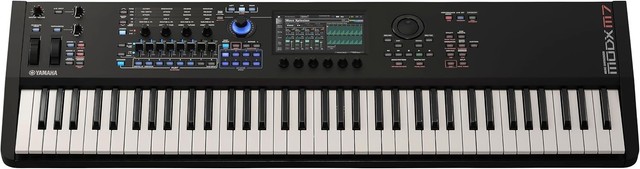
Yamaha’s current mid-range synth workstation in the 76-key size, running three engines — AN-X analog modeling, FM-X, and AWM2 sample playback — through a semi-weighted FSB keybed built for synth players rather than pianists. It replaced the older MODX7+ in Yamaha’s lineup and adds a Super Knob and eight physical faders for hands-on sound sculpting.
- 76-key semi-weighted FSB keybed
- Three sound engines — AN-X, FM-X and AWM2 — up to 268-note combined polyphony
- 8 physical faders plus a Super Knob for real-time control
- 10.7GB of AWM2 wave memory with a color touchscreen
- Genuinely lightweight for a 76-key synth workstation
- Faders and Super Knob make sound design tactile rather than menu-driven
- Current model in Yamaha’s lineup, not a discontinued holdover
- Semi-weighted action isn’t a substitute for hammer-action piano feel
- FM-X programming has a real learning curve
- No dedicated audio interface built in
Kurzweil PC4-7
Marketed by Kurzweil as a ‘performance controller’ as much as a synth, the PC4-7 pairs a 76-key semi-weighted keybed with velocity and aftertouch sensitivity, Kurzweil’s V.A.S.T. synthesis engine, and a 16-track sequencer, all while staying under 20 lb. It suits players who want deep onboard sound design plus a keybed light enough to gig with regularly.
- 76-key semi-weighted keybed with velocity and aftertouch
- 256-voice polyphony, 2GB of instrument samples, 1,000-plus presets
- 6-operator FM engine plus Kurzweil V.A.S.T. editing
- Built-in 16-track sequencer, under 20 lb
- Under 20 lb is genuinely light for a 76-key workstation
- V.A.S.T. synthesis goes deeper than most workstations at this price
- Doubles as a capable USB or 5-pin MIDI controller for other gear
- Semi-weighted action, not a piano-realistic hammer feel
- Menu system feels less modern than newer competitors
- Smaller third-party preset community than Yamaha or Korg
Roland Juno-DS76
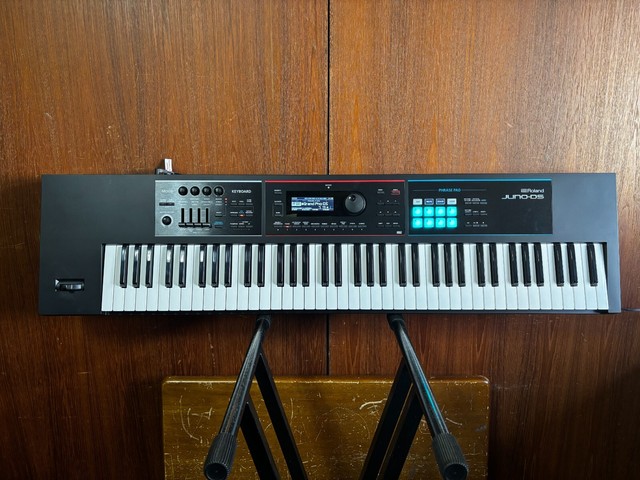
Roland’s budget-friendly 76-key synthesizer, built around a velocity-sensitive keybed with over 1,200 preset patches, an eight-track pattern sequencer, and a mic input with vocal effects built in. At 15.2 lb it’s the lightest full instrument on this list, and it works as a class-compliant USB audio/MIDI interface for recording straight into a DAW.
- 76-key velocity-sensitive keybed with 8 pads
- 1,200-plus preset patches, multi-effects, chorus and reverb
- 8-track pattern sequencer
- USB audio/MIDI interface with mic input and vocal effects
- Lightest 76-key instrument in this roundup at 15.2 lb
- Lowest price of any full workstation on this list
- Doubles as an audio interface, useful for home recording
- Unweighted synth-action keybed, not semi-weighted or hammer
- Onboard sounds are serviceable rather than premium
- Smaller display and fewer physical controls than pricier workstations
Vox Continental 73 BK
A 73-key semi-weighted waterfall keyboard built for organ and vintage-synth textures rather than piano realism, descended from Vox’s 1960s Continental combo organs. The waterfall keys — flat-fronted, no gaps between them — are shaped specifically for the sliding glissandos organ players use, and the engine leans into vintage transistor-organ and analog tones.
- 73-key semi-weighted waterfall keybed
- Vintage-voiced organ and analog-style synth engine
- Onboard effects built around Vox’s combo-amp heritage
- Compact, gig-oriented chassis
- Waterfall keybed is genuinely better than standard keys for organ glissandos
- Distinctive vintage organ and synth voicing not duplicated by mainstream workstations
- Lighter and more compact than most 73-key stage pianos
- Narrow focus on organ and vintage tones limits general-purpose use
- Semi-weighted waterfall action feels unfamiliar if you’re used to standard piano keys
- Smaller dealer network than Roland, Korg or Yamaha

Roland Fantom-07
Roland’s flagship synth workstation in a 76-key configuration, with a velocity-sensitive synth-action keybed, 16 RGB backlit pads, a color touchscreen, and channel aftertouch. It’s built for programming and performing layered sounds live, with physical knobs, sliders and pads standing in for the deep-menu editing older workstations relied on.
- 76-key velocity-sensitive synth-action keybed with aftertouch
- 16 RGB performance pads
- Full-color touchscreen with high-resolution knobs and sliders
- 16-part multitimbral sound engine
- Extensive hands-on controls reduce menu-diving during sound design
- Aftertouch on a synth-action keybed is relatively unusual
- Flagship-level sound engine and build quality
- Synth-action keybed has no weighting, so piano parts feel thin
- Premium price close to some 88-key flagship workstations
- Large control surface makes it less travel-friendly than smaller boards

Yamaha Genos2
A flagship arranger workstation rather than a synth or stage piano, built for players who want full backing-band styles and voicings for solo performance, not just a keybed to program sounds on. Its 76-key semi-weighted FSX keybed carries aftertouch, and the 9-inch touchscreen runs Yamaha’s full arranger engine — a genuinely different tool than anything else in this size range.
- 76-key semi-weighted FSX keybed with aftertouch
- 9-inch color touchscreen
- 1,990 voices, 75 drum and SFX kits, 800 backing styles
- Assignable knobs and faders with LED status displays
- Only true arranger workstation in the 76-key size — a different use case than a synth or stage piano
- Extensive onboard backing-band styles for solo performers
- Aftertouch-enabled keybed is unusual for an arranger keyboard
- Overkill and expensive if you don’t actually want arranger and backing-style features
- Large and heavy relative to a plain controller
- Learning the style and arranger workflow takes real time
Buying tips
- Decide on key action before key count: try semi-weighted, hammer-action and synth-action boards side by side if you can — the feel under your fingers matters more day-to-day than whether you own 73, 76 or 88 keys.
- If you mostly play synth patches, pads and organ, a lighter semi-weighted or synth-action board like the Roland Juno-DS76 or Yamaha MODX M7 will save your back on load-in night.
- If piano realism for practice or recording is the priority, budget for hammer action and accept the extra weight — there’s no way around it at this key count.
- Work out whether you need a MIDI controller with no sounds or a full instrument — a $500 controller and a laptop can replace a $3,000 stage piano if all you’re doing is triggering software instruments.
- Measure your car trunk and gig bag before buying anything over 20 lb; several boards here are workstation-class and heavier than they look in photos.
- If organ playing — glissandos and smears — matters to you, look specifically for a waterfall keybed; the flat, gap-free key fronts on the Nord Stage 4 Compact and Vox Continental are built for that technique and a standard keybed isn’t.
- Check for aftertouch (pressure sensitivity after a key is pressed) if you use expressive synth patches — not every board here has it, and it isn’t always mentioned prominently in store listings.
- Confirm USB MIDI class-compliance with your DAW or software instrument before buying; most boards here work plug-and-play, but always check against your specific software’s requirements.
As an Amazon Associate and eBay Partner, toptenpick.com earns from qualifying purchases. Prices and availability are subject to change.